
Quick Overview
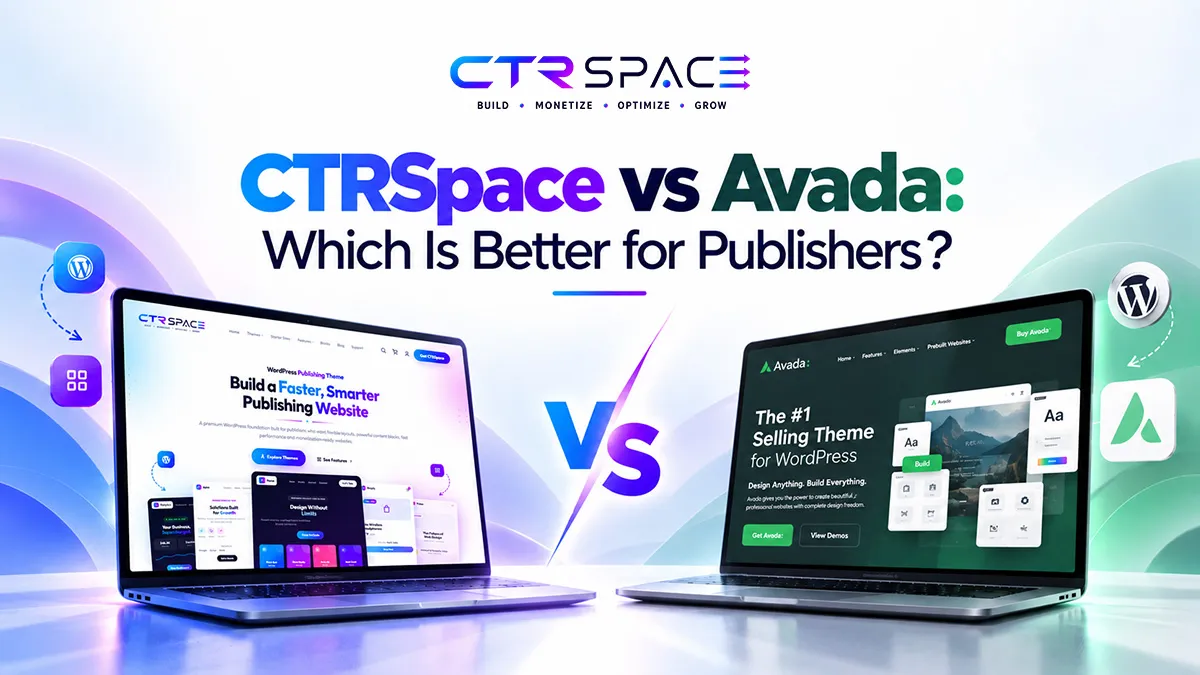
CTRSpace is the better fit for publishers and content-driven websites, while Avada is the more mature choice for users primarily looking for a general-purpose visual WordPress website builder. Avada is an established all-in-one WordPress website builder. Its current ecosystem includes a Live Visual Builder, Layout Builder, Header and Footer Builders, Form Builder, WooCommerce Builder, Performance Wizard, 113 prebuilt websites, 600+ reusable Avada Studio content blocks, and 120+ design and layout elements. Avada Website Builder
CTRSpace takes a different approach. It is being developed as a publisher-first WordPress ecosystem rather than only a visual website builder. CTRSpace currently has 40+ completed themes across 10 major categories, including dedicated designs for blogs, magazines, news, reviews, viral content, business, SaaS, eCommerce, hospitality, healthcare, real estate, local services and education.
For publishers specifically, the theme library goes deeper than a generic “blog” template. It includes dedicated designs for Personal Blogs, Lifestyle Blogs, Magazines, News, Entertainment & Celebrity, Sports News, Politics & Opinion, Travel Blogs, Viral & Trending sites, Quiz & Trivia, Tech & Gadget Reviews, Movie & TV Reviews, Life Hacks and other content models.
Beyond themes, CTRSpace’s broader architecture connects site building with Content & AI, SEO & Search Intelligence, advertising and monetization, analytics, audience growth, experimentation, affiliate intelligence, GEO/AI Search Intelligence, multi-site operations and AI-assisted publisher optimization.
The core distinction is simple:
Avada is built primarily around creating and customizing WordPress websites. CTRSpace is built around creating, publishing, monetizing, measuring and continuously improving content-driven websites.
Key Takeaways
- CTRSpace is more purpose-built for publishers. Its product direction connects the website with content creation, search performance, audience behavior, monetization, and optimization.
- CTRSpace currently has 40+ completed themes across 10 major categories, with particularly strong coverage of news, magazines, blogs, reviews and other publishing models.
- Avada has the more mature general-purpose visual builder. Its current platform offers 113 prebuilt websites, 120+ design elements, and dedicated visual tools for layouts, headers, footers, forms, and WooCommerce.
- Avada is not inherently slow. It provides its own performance controls, so performance comparisons should be based on actual implementations rather than generic “bloated theme” claims.
- CTRSpace’s main differentiation appears after publication. Its architecture is intended to connect SEO, search intelligence, analytics, advertising, affiliate revenue, and experimentation around the content itself.
- Avada remains a strong choice for general business sites, portfolios, stores and design-led projects. CTRSpace becomes more compelling when content and publishing are central to the business.
CTRSpace vs Avada at a Glance
| Area | CTRSpace | Avada |
| Primary focus | Publisher-first WordPress ecosystem | General-purpose WordPress website builder |
| Ready-made designs | 40+ completed themes | 113 prebuilt websites |
| Publishing focus | Core specialization | One of many supported use cases |
| News, magazine & blog themes | Dedicated theme range | Available within broader library |
| Review & content sites | Dedicated review, viral and content themes | Can be built and customized |
| Visual website building | Website customization + publishing workflow | Major strength |
| SEO | SEO and Search Intelligence architecture | SEO-friendly foundation + integrations |
| Publisher analytics | Part of broader platform architecture | Not Avada’s primary product focus |
| Advertising & monetization | Publisher-focused architecture | Can be implemented, but not core positioning |
| Experimentation | Dedicated optimization direction | Not core builder functionality |
| Affiliate intelligence | Dedicated product direction | Not core Avada functionality |
| AI-search intelligence | Dedicated product direction | Not core Avada positioning |
| Best suited for | Publishers and content-driven businesses | Broad WordPress website creation |
What Are CTRSpace and Avada?
At first glance, both products can help someone launch a WordPress website. Their underlying goals, however, are different.
Avada: A Mature Visual WordPress Website Builder
Avada combines a WordPress theme with an integrated visual-building ecosystem. Instead of requiring a separate page builder for most design work, Avada provides tools for visually creating pages, headers, footers, layouts, forms, menus, and WooCommerce experiences.
Its current Live Visual Builder includes drag-and-drop editing and more than 120 design and layout elements, while Avada currently advertises 113 prebuilt websites that can be imported and customized. Avada also provides access to 600+ Avada Studio content blocks, six bundled premium plugins, lifetime software updates for the license, and six months of initial support.
Its central proposition is therefore easy to understand:
Build almost any type of WordPress website with extensive visual control.
CTRSpace: A Publisher-First WordPress Ecosystem
CTRSpace begins with a different problem: how to build and grow a content-driven website. Its current theme catalog contains 40+ completed themes across 10 major categories. Those categories extend from Blog & Magazine and Viral, Reviews & Content into Business & Corporate, Technology & SaaS, eCommerce & Retail, Food & Hospitality, Health, Fitness & Beauty, Real Estate, Professional Services and Education.
Publishing is where the catalog becomes particularly distinctive. CTRSpace doesn’t treat every content website as the same type of “blog.” Dedicated themes address different editorial models, including news, magazines, personal and lifestyle blogs, sports journalism, politics and opinion, entertainment, travel, viral content, quizzes, technology reviews and movie/TV reviews.
The wider catalog also includes themes for SaaS businesses, AI tools, software companies, online stores, restaurants, hotels, healthcare providers, fitness businesses, real estate companies, law firms, local-service businesses and educational organizations.
Users can begin with a ready-made design through a straightforward Choose a Site → One-Click Import → Customize workflow. More importantly, the theme is intended to be the starting layer rather than the entire product. CTRSpace’s broader vision connects the website with the workflows a publisher needs after launch.
Website Building and Customization
Avada currently has the advantage when the comparison is limited to visual-builder maturity. Its Live Visual Builder allows front-end drag-and-drop editing, while separate tools cover layouts, headers, footers, forms, off-canvas content, and WooCommerce. Avada also emphasizes responsive controls across desktop, tablet and mobile.
That breadth makes Avada particularly useful for agencies, freelancers and businesses building very different kinds of websites. A developer could use the same ecosystem for a restaurant, corporate site, portfolio or online store. CTRSpace doesn’t need to beat Avada by becoming another general-purpose visual builder.
Its stronger differentiation is what happens around the website-building layer. For a publisher, designing the website is only the beginning. Once content starts going live, the team needs to understand search visibility, reader engagement, monetization, content opportunities, and what should be improved next. That broader operating workflow is where CTRSpace is intended to differentiate itself.
Themes and Prebuilt Websites
Both platforms give users professionally designed starting points rather than forcing them to begin with a blank WordPress installation.
Avada currently offers 113 prebuilt websites covering a wide variety of industries and website types. Users can import a design and then customize it through Avada’s visual-building system. CTRSpace currently offers 40+ completed themes across 10 categories. Its catalog is also broad, covering businesses, SaaS, eCommerce, hospitality, healthcare, real estate, education and local services, but it provides particularly detailed coverage for publishing.
A publisher can start from a design intended specifically for news, magazines, sports journalism, politics and opinion, entertainment, technology reviews, movie reviews, viral content, quizzes, lifestyle publishing or personal blogging instead of adapting a generic multipurpose layout.
This matters because a corporate website, news publication, and product-review site may all use WordPress, but they don’t have the same information architecture, reader journeys, or monetization requirements. Avada currently has the larger established prebuilt-site library. CTRSpace combines a broad theme collection with deeper specialization around publishers and content-driven websites.
Publishing Features
This is where CTRSpace’s positioning becomes more distinct. A publishing website needs more than attractive pages. Readers need to discover stories, navigate categories, move between related articles, and engage with commercial or subscription elements without compromising the reading experience.
CTRSpace’s publisher-focused foundation is designed around those requirements, including homepage, archive and article templates; news, category and trending blocks; tables of contents; CTA blocks; affiliate/product/comparison blocks; advertising placements; and newsletter components.
That creates a more natural foundation for news websites, magazines, review publications and niche content businesses. Avada can absolutely build blogs, news websites and magazines. Its dynamic content and layout tools provide considerable flexibility for doing so. The difference is therefore not whether Avada can build a publishing website. It can. The distinction is that publishing is one of many Avada use cases, whereas publishing is central to CTRSpace’s product strategy.
Performance and Core Web Vitals
A fair comparison should not repeat the common claim that multipurpose themes are automatically slow. Avada gives users considerable control over performance and includes a dedicated Performance Wizard. Its product positioning explicitly emphasizes the ability to control website features and make performance-related decisions.
Actual WordPress performance depends on much more than the theme name: hosting, plugins, fonts, images, third-party scripts, advertising, caching and implementation all matter.
CTRSpace’s performance approach is particularly relevant to publishers because it is designed around content-heavy and monetized websites. Its architecture includes Core Web Vitals optimization, lazy loading, asset optimization, modern image and font handling, caching/CDN compatibility and CLS-safe advertising containers.
The advertising component matters. An ad-supported publication needs to consider not only how quickly an article loads, but whether advertising causes content to move unexpectedly while someone is reading.
So the defensible comparison isn’t: CTRSpace is fast; Avada is slow.
It is: Avada provides extensive performance controls for a broad range of websites, while CTRSpace is designed to account for performance requirements specific to content-heavy and monetized publishing sites.
SEO and Search Intelligence
Avada provides a suitable technical foundation for SEO and integrates with established WordPress SEO products, including Yoast SEO. That makes it inaccurate to describe Avada as weak or unsuitable for SEO. CTRSpace’s differentiation is that search optimization is intended to sit closer to the publishing workflow itself.
Its SEO architecture covers areas such as keywords, metadata and SERP previews, canonical controls, robots directives, sitemap control, breadcrumbs, social metadata, structured data, redirects and internal-link recommendations.
The Search Intelligence layer then goes beyond page configuration into actual performance signals: queries, impressions, clicks, CTR, average position, winning and declining pages, keyword gains and losses, content decay, cannibalization and search opportunities.
For a publisher managing hundreds or thousands of URLs, that changes the question from:
“Have we optimized this page?”
to:
“Where are we losing organic-search opportunities, and what should we improve next?”
That’s a meaningful difference between a website-building platform and a publisher-focused search workflow.
Analytics, CTR and Content Intelligence
Traffic is useful, but pageviews alone don’t tell a publisher whether content is accomplishing its job. A high-traffic article may generate weak engagement or little revenue. A smaller article might produce significantly more affiliate clicks, advertising revenue or conversions.
CTRSpace’s analytics direction is built around connecting page, category and author performance, engagement, scroll depth, CTA clicks, outbound clicks, affiliate clicks and search-performance data.
Its experimentation layer then extends measurement into improvement through capabilities such as headline testing, SEO-title testing, featured-image testing, CTA and affiliate-button testing, ad-position experiments and conversion/revenue measurement.
The intended workflow becomes:
Identify an opportunity → understand what is happening → test an improvement → measure the result.
That is a different product problem from visual website construction, and it is one of the areas where CTRSpace’s publisher-first positioning becomes most meaningful.
Advertising, Affiliate Marketing and Monetization
Monetization is another area where the needs of a publisher differ from those of a standard business website. Avada has strong commercial capabilities, particularly through its WooCommerce integration and visual WooCommerce Builder. Publishers, however, often monetize through a mixture of display advertising, affiliate links, sponsored content, newsletters, subscriptions and lead generation rather than relying primarily on product sales.
CTRSpace’s advertising architecture is designed around publisher requirements such as AdSense integration, direct advertising, responsive and in-content placements, device and content rules, impressions, CTR, RPM and revenue by page, category or author.
Its wider architecture also considers content-depth ad insertion, ad-density controls and CLS-safe loading. Google Ad Manager support, CPM and viewability reporting are planned rather than available today. Affiliate publishing is treated as another dedicated workflow, covering affiliate-link management, cloaked redirects with click tracking, deep links, commission sync across Awin, CJ, ShareASale and Amazon, sub-ID attribution back to the sending article, and article-level affiliate performance. Merchant discovery, product feeds, coupons and merchant recommendations are planned rather than available today.
This leads to a more useful publisher question than simply:
“Can I place an ad on this page?”
The real question is:
“Which content generates revenue, which placements work, and how can monetization improve without damaging the reader experience?”
AI Search and the Changing Discovery Landscape
AI-search functionality should only be part of this comparison where it addresses a real publisher need. CTRSpace’s broader architecture includes Content AI for editorial workflows and a dedicated GEO & AI Search Intelligence direction for understanding visibility across emerging AI-mediated discovery environments.
That direction includes concepts such as AI-search visibility, brand/domain mentions, cited URLs, topic visibility, competitor visibility, citation gaps, and AI-search opportunities. This is increasingly relevant because Google now provides dedicated Search Console reporting for generative Search visibility, including AI Overviews and AI Mode.
But CTRSpace—or any other platform—cannot guarantee inclusion in Google AI results.
Google’s current guidance explicitly says that established SEO practices remain foundational for generative Search and places particular emphasis on unique, valuable, non-commodity content. Google also says there is no need to create special AI markup or rewrite content into artificial “AI-friendly” chunks.
CTRSpace’s relevant advantage is therefore measurement and workflow, not an AI-ranking shortcut. For publishers, traditional search visibility and AI-mediated discovery are becoming two parts of a broader content-discovery landscape.
Pricing and Licensing
Avada’s pricing model is straightforward for a single website. Its current Live Builder page lists the product at $69, and purchases include six months of support. Avada’s registration model also permits one qualifying staging, development or local installation per top-level domain.
This is a practical model for individuals and businesses managing one or a small number of sites. CTRSpace’s verified pricing hasn’t been supplied for this comparison, so it would be misleading to claim that CTRSpace is cheaper or provides better monetary value solely on price.
The more relevant consideration for publishers will be total operating value: how much functionality the platform can consolidate across themes, publishing, SEO, analytics, monetization, and optimization. Until CTRSpace pricing is finalized or provided, that part of the comparison should remain factual rather than speculative.
Where Avada Is Better
Avada is currently the stronger option when the primary requirement is a mature general-purpose visual website builder. Its combination of 113 prebuilt websites, 600+ Studio content blocks, 120+ design and layout elements, dedicated visual builders, WooCommerce functionality, documentation, and a long-established ecosystem gives users enormous design flexibility.
That makes Avada particularly compelling for corporate websites, portfolios, eCommerce stores, agencies and freelancers who regularly build unrelated types of sites. Users who prefer assembling specialist functionality through the wider WordPress plugin ecosystem may also appreciate that flexibility. CTRSpace doesn’t need to hide those strengths to make a convincing comparison.
Where CTRSpace Is Better for Publishers
CTRSpace becomes more compelling when content itself is the business. Its 40+ completed themes across 10 categories provide a broad website foundation, while its publishing catalog gives more specialized starting points to news sites, magazines, blogs, reviews, entertainment sites, and other editorial models. The bigger difference is what surrounds those themes.
CTRSpace is designed to connect the publishing site with content workflows, SEO, search intelligence, reader analytics, advertising, affiliate monetization, experimentation and ongoing optimization. For a professional publisher, those capabilities are interconnected.
An article can gain impressions but lose clicks. Another can attract traffic but fail to engage readers. A third can generate substantial affiliate or advertising revenue despite receiving less traffic. Understanding those relationships is much more valuable than looking at each metric in isolation.
That’s why CTRSpace is particularly relevant to news publishers, digital magazines, niche blogs, review websites, affiliate publishers, sports publications, finance and crypto publishers, entertainment sites, and other content-led businesses.
CTRSpace vs Avada: Which Should You Choose?
| Choose CTRSpace when… | Choose Avada when… |
| Content is central to the business | Visual website creation is the main priority |
| You operate a news, magazine, blog or review site | You build many unrelated types of websites |
| Organic search is a major acquisition channel | Extensive visual customization is important |
| Display ads or affiliate revenue matter | WooCommerce is central to the project |
| You want publisher-specific themes | You want an established general-purpose design ecosystem |
| Search, analytics and monetization need to work together | You prefer assembling specialist tools separately |
| The website is an ongoing publishing operation | The primary goal is building and maintaining the website |
Final Verdict
For publishers and content-driven businesses, CTRSpace is the more purpose-built choice. For general-purpose visual WordPress website building, Avada is currently the more mature platform. Avada’s strength is clear. It gives users an established visual-building environment, a large prebuilt-site library, extensive design controls, and strong WooCommerce capabilities. For many conventional WordPress projects, those are exactly the features that matter.
CTRSpace is solving a different problem. Its 40+ completed themes provide the website foundation, but the broader proposition is to connect that foundation with the systems a publisher needs to grow: content, search visibility, reader behavior, monetization, experimentation and continuous optimization.
The distinction becomes clearest after a site launches. A general-purpose website builder primarily helps answer:
How should we build and present this website?
A publisher operating platform also needs to answer:
What should we publish next? Which content is losing search visibility? Where are we losing clicks? What keeps readers engaged? Which content generates revenue? What should we test? What should we improve next?
For publishers, those questions don’t sit outside the website. They are the business. That is where CTRSpace has the opportunity to provide substantially more value than a conventional multipurpose WordPress builder.
Frequently Asked Questions
Is CTRSpace better than Avada for publishers?
CTRSpace is the more purpose-built option for publishers and content-driven businesses. Its broader architecture connects website creation with content workflows, search intelligence, analytics, monetization, and optimization. Avada is stronger as a mature, general-purpose visual WordPress website builder.
How many themes does CTRSpace have?
CTRSpace currently has 40+ completed themes across 10 major categories in the catalog used for this comparison. These cover publishing, reviews, business, SaaS, eCommerce, hospitality, healthcare, real estate, professional services, education, and other website types.
Which is better for a news or magazine website?
CTRSpace is the stronger fit when publishing is the website’s primary business model. Its theme catalog includes dedicated designs for News, Magazines, Sports News, Politics & Opinion, Entertainment and other editorial formats. Avada can also build news and magazine sites, but publishing is one use case within its much broader website-building ecosystem.
Which is better for general WordPress website design?
Avada currently has the advantage for general-purpose visual website creation. Its Live Visual Builder, 113 prebuilt websites, and 120+ design elements provide an established environment for building many different types of websites.
Which is better for SEO: CTRSpace or Avada?
Both can support search-friendly websites, but their approaches differ. Avada provides an SEO-compatible WordPress foundation and integrates with specialist plugins such as Yoast SEO. CTRSpace is designed to bring SEO closer to the publishing workflow by connecting on-page optimization with search-performance intelligence such as impressions, clicks, CTR, rankings, declining content, and optimization opportunities. For publishers whose organic search performance is central to the business, CTRSpace has a more specialized proposition.
Is Avada slow?
Avada should not be described as inherently slow. It includes dedicated performance functionality, and actual website performance depends on hosting, plugins, scripts, media, caching, and configuration as well as the theme itself.
Is CTRSpace an Avada alternative?
Yes, particularly for content-driven websites. Users primarily looking for a mature multipurpose visual builder may prefer Avada. Publishers looking for a platform designed around themes, content, search performance, audience behavior, monetization, and continuous optimization are closer to CTRSpace’s intended use case.
Who should consider CTRSpace instead of Avada?
CTRSpace is most relevant when a website has become more than a design project and operates as a content business—for example, a news site, magazine, niche publication, review website, affiliate publisher or another business where organic discovery, reader engagement and content monetization directly affect growth
