Signal Surges to No.1 Downloaded App in the Netherlands

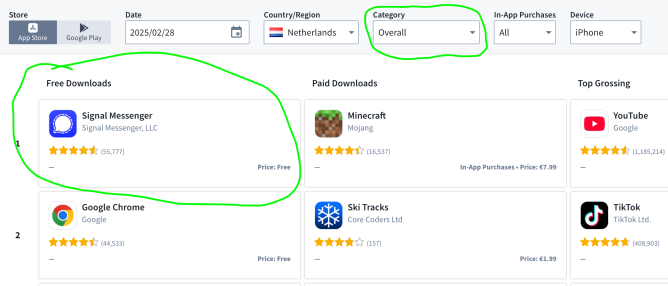
The privacy-focused messaging app Signal has experienced an extraordinary rise in the Netherlands. Over the past month, it has topped app store rankings for iOS and Android. According to multiple app intelligence platforms, including Sensor Tower and AppFigures, Signal has consistently remained the most downloaded free app in the country. This sharp increase occurs amid rising global concerns about data privacy and government surveillance. But why has the Netherlands, in particular, undergone such a drastic shift toward Signal?

Growing Awareness of Digital Privacy

While Signal has seen waves of adoption in the past—often in response to WhatsApp’s controversial policy changes or major geopolitical events—its current surge in popularity appears to be driven by a deeper shift in public perception. Signal President Meredith Whittaker, in an interview with the Dutch newspaper De Telegraaf, noted that the app has seen 25 times more registrations in the Netherlands compared to previous periods. While the exact timeframe of this growth wasn’t disclosed, she attributed the surge to a mix of factors:

“Growing awareness of privacy, distrust of big tech, and the political reality in which people realize how vulnerable digital communication can be.”

Signal’s Unmatched Privacy Standards

Unlike mainstream messaging apps such as WhatsApp, Telegram, and Messenger, Signal is operated by a not-for-profit foundation rather than a data-driven corporation. This means no targeted ads, metadata tracking, and full end-to-end message encryption. It has become the go-to alternative for Dutch citizens increasingly skeptical of Big Tech’s influence, especially in light of Meta’s recent privacy breaches, Signal.

A 958% Download Surge

Data from AppFigures shows just how dramatic Signal’s growth has been in the Netherlands:

  • December 2024: 22,000 downloads
  • January 2025: 99,000 downloads
  • February 2025: 233,000 downloads

That’s an explosive 958% increase in three months, far outpacing growth in neighboring European markets. For comparison:

  • Belgium: +250%
  • Sweden: +153%
  • Denmark: +95%
Image Credits:Sensor Tower / screenshot

Anti-Big Tech Sentiment in Europe

Dutch digital rights organizations suggest that rising tensions between the U.S. government and European tech policies have contributed to the adoption boom. Rejo Zenger, senior policy advisor at Bits of Freedom, explains: “The Dutch are highly dependent on U.S. tech giants, and recent global developments have intensified discussions about digital sovereignty. We are seeing a broader debate—not just ‘Which messenger should I use?’ but ‘How can we reduce our reliance on foreign-controlled platforms?’”

Similarly, Vincent Böhre, director of Privacy First, believes the political climate has played a role. “Since Trump’s re-election, there has been widespread criticism of U.S. Big Tech firms in Dutch media. This has led even non-technical users to seek privacy-friendly alternatives like Signal.”

A European Trend in the Making?

Signal’s dominance in the Netherlands could be the start of a wider European shift. Governments across the continent are cracking down on end-to-end encryption, pressuring companies like Apple to weaken privacy protections. Speaking at RightsCon 2025 in Taiwan, Whittaker reaffirmed Signal’s firm stance against compliance with such regulations:

“Signal’s position is clear—we will never weaken encryption or compromise the security guarantees people depend on.” She further stated in an interview with Swedish broadcaster SVT that Signal would rather exit a market than comply with data retention laws:
“If forced to store messages, we would rather leave Sweden entirely. Breaking encryption is simply not an option for us.”

What’s Next for Signal?

With its growing adoption in the Netherlands and across Europe, Signal proves that privacy-first alternatives can compete against Big Tech giants. If public distrust of corporate data practices continues, the messaging app could see similar adoption waves in other privacy-conscious nations in the coming months. For now, the Netherlands is leading the charge, and it may be the beginning of a much larger movement towards secure and independent digital communication.

Read More: DeepSeek Claims 545% AI Profit Margin After Rapid Industry Rise
TikTok Returns to App Stores in the US and the Ownership Battle Continues

The odyssey of TikTok in the United States has been an exciting reality show with a high stakes infused series of courtroom battles and political backroom dealings along with last minute plot twists in between. A month-long disappearing act has made its grand re-entry to app stores of the U.S, however the drama might not be over yet. With concerns over national security, executive orders, and the prospect of U.S ownership looming, the events of the TikTok saga continue to unfold like a binge worthy series.

TikTok returns to the app stores in the United States, marking yet another chapter in its motto to survive. For nearly a month, the highly hyped short-video app, TikTok, was not available for download. Then, it re-entered the U.S today when Apple and Google reinstated it in their respective app stores. This follows the temporary ban earlier on national security grounds. Similarly, other apps of ByteDance, including the video editor CapCut and social media platform Lemon8, were also restored. However, without certainty as to whether it is going to be bought by one of the many incoming tech giants waiting in line for the apparent bidding war, the app’s future hangs in the balance.

TikTok’s Ban:

Government scrutiny of TikTok has been ongoing in the U.S for several years, with concerns related to national security risks from China’s ownership of ByteDance. In 2024, former President Biden signed a law requiring that by January 19, 2025, ByteDance has to dissociate from operating TikTok in the U.S or see the app outlawed altogether.

The law threatened significant financial penalties against any app store operators who failed to comply with it, resulting in Apple and Google pulling TikTok from their platforms. ByteDance tried to challenge the ruling, but on January 17, the Supreme Court reaffirmed the law making an obligation for TikTok to find a non-Chinese buyer or be permanently banned in the United States.

Trump’s Order and TikTok’s Return:

However, things turned around on January 20 when the newly elected President of the U.S, Donald Trump, signed an executive order putting the ban on hold for 75 days. This afforded ByteDance further tried to find a buyer for TikTok’s U.S operations, thus renewing support for the application from service providers like Oracle.

That is not the end of the road, rather the Apple and Google postponed TikTok’s return to their stores on account of uncertainty about the legal penalties that would be imposed under the law’s deferral. This makes a rather different situation for those users who had installed TikTok would be able to continue to use it, whereas others who uninstalled it would not be able to download it again. Thanks to the immediate tech industry response regarding potential U.S ownership of TikTok, the long-standing competitor of short video-sharing apps is witnessing one of the greatest upsurge of all time.

Of course, Trump would have the government owning 50% of the stake jointly with partner companies and setting up, as part of the deal, a sovereign wealth fund for the possible purchase of TikTok’s U.S operations, supposedly, Oracle and Microsoft are notable contenders for the acquisition. On the other hand, TikTok enemies have been aggressive in squeezing the situation. Social platforms such as X and Bluesky have introduced specific vertical video feeds to appeal to TikTok users, while Meta announced that it would develop a video-editing app for CapCut competition.

TikTok’s Popularity and Beyond:

As it stands in the year 2023, TikTok remains one of the most popular apps in the world in the United States. According to analytics company Sensor Tower, in 2022, it was the second most downloaded app in the U.S, with 52 million downloads. While the immediate future of TikTok in the U.S seems secured, its long term future depends on whether ByteDance would negotiate a sale to please regulators.

There is little doubt that the app’s popularity will be affected by all these factors, but more by how the company, U.S regulators, and future investors move forward as they all navigate through what will be a complex political and legal maze. All eyes will be on negotiating drama between ByteDance, U.S tech giants, and the federal government as time runs out with the 75-day extension. The one thing absolutely certain is that this is not the final twist, and the world will wait to see what happens next with the effects of this latest change in TikTok.

Read More: Elon Musk’s Battle to Buy OpenAI