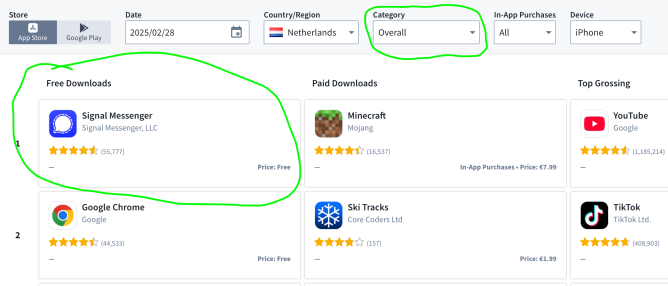
The privacy-focused messaging app Signal has experienced an extraordinary rise in the Netherlands. Over the past month, it has topped app store rankings for iOS and Android. According to multiple app intelligence platforms, including Sensor Tower and AppFigures, Signal has consistently remained the most downloaded free app in the country. This sharp increase occurs amid rising global concerns about data privacy and government surveillance. But why has the Netherlands, in particular, undergone such a drastic shift toward Signal?
Growing Awareness of Digital Privacy
While Signal has seen waves of adoption in the past—often in response to WhatsApp’s controversial policy changes or major geopolitical events—its current surge in popularity appears to be driven by a deeper shift in public perception. Signal President Meredith Whittaker, in an interview with the Dutch newspaper De Telegraaf, noted that the app has seen 25 times more registrations in the Netherlands compared to previous periods. While the exact timeframe of this growth wasn’t disclosed, she attributed the surge to a mix of factors:
“Growing awareness of privacy, distrust of big tech, and the political reality in which people realize how vulnerable digital communication can be.”
Signal’s Unmatched Privacy Standards
Unlike mainstream messaging apps such as WhatsApp, Telegram, and Messenger, Signal is operated by a not-for-profit foundation rather than a data-driven corporation. This means no targeted ads, metadata tracking, and full end-to-end message encryption. It has become the go-to alternative for Dutch citizens increasingly skeptical of Big Tech’s influence, especially in light of Meta’s recent privacy breaches, Signal.
A 958% Download Surge
Data from AppFigures shows just how dramatic Signal’s growth has been in the Netherlands:
- December 2024: 22,000 downloads
- January 2025: 99,000 downloads
- February 2025: 233,000 downloads
That’s an explosive 958% increase in three months, far outpacing growth in neighboring European markets. For comparison:
- Belgium: +250%
- Sweden: +153%
- Denmark: +95%
Anti-Big Tech Sentiment in Europe
Dutch digital rights organizations suggest that rising tensions between the U.S. government and European tech policies have contributed to the adoption boom. Rejo Zenger, senior policy advisor at Bits of Freedom, explains: “The Dutch are highly dependent on U.S. tech giants, and recent global developments have intensified discussions about digital sovereignty. We are seeing a broader debate—not just ‘Which messenger should I use?’ but ‘How can we reduce our reliance on foreign-controlled platforms?’”
Similarly, Vincent Böhre, director of Privacy First, believes the political climate has played a role. “Since Trump’s re-election, there has been widespread criticism of U.S. Big Tech firms in Dutch media. This has led even non-technical users to seek privacy-friendly alternatives like Signal.”
A European Trend in the Making?
Signal’s dominance in the Netherlands could be the start of a wider European shift. Governments across the continent are cracking down on end-to-end encryption, pressuring companies like Apple to weaken privacy protections. Speaking at RightsCon 2025 in Taiwan, Whittaker reaffirmed Signal’s firm stance against compliance with such regulations:
“Signal’s position is clear—we will never weaken encryption or compromise the security guarantees people depend on.” She further stated in an interview with Swedish broadcaster SVT that Signal would rather exit a market than comply with data retention laws:
“If forced to store messages, we would rather leave Sweden entirely. Breaking encryption is simply not an option for us.”
What’s Next for Signal?
With its growing adoption in the Netherlands and across Europe, Signal proves that privacy-first alternatives can compete against Big Tech giants. If public distrust of corporate data practices continues, the messaging app could see similar adoption waves in other privacy-conscious nations in the coming months. For now, the Netherlands is leading the charge, and it may be the beginning of a much larger movement towards secure and independent digital communication.
Read More: DeepSeek Claims 545% AI Profit Margin After Rapid Industry Rise