Musk’s DOGE Released AI Chatbot for Government General Services Administration

Musk’s DOGE has started rolling out AI Chatbot to General Services Administration (GSA) Employees. General Services Administration (GSA) manages government real estate and certain IT efforts. The chatbot would help the employees with their daily tasks by automating them. An internal memo was given to the employees to let them know which tasks they could automate.

The Chatbot, GSAi, gives users 3 models to work with and the main idea is to use it to analyze contracts and procurement data. It should be remembered that GSA is one of the many agencies that faced job cuts. Reportedly, around 100 workers were affected due to what they call proper sizing.

The AI vs Workers battle

There has been this notion that AI will eventually replace human workers. Such layoffs always add more fuel to such predictions. While AI is improving rapidly, it is still nowhere near human intelligence. However, AI has proven more proficient in tasks like data entry, as automated systems can process data faster than humans. Similarly, with customer support and FAQ lists, AI Chatbot can do a better job. Similarly, Robotic automation, basic content writing, and accounting are other examples where AI outshines.

AI creating Jobs?

The counterargument is that while AI is replacing human workers in some capacities, AI also creates jobs. For example, AI development/engineering has seen more demand for people with the required skill set. Similarly, on the Data side, Prompt engineers and AI-assisted content Creators are some of the skill sets that are very hot in the market due to AI development. From this analysis, it is clear that humans must do more technical jobs and leave the simple, repetitive tasks to AI. Now, it remains to be seen if humans can step up the ladder and fill the more technical roles in more significant numbers.

DOGE is a villain

Elon Musk’s DOGE has come under heavy criticism from companies. DOGE stands for Department Of Government Efficiency. DOGE has been involved with the government to cut costs by replacing workers with AI cost-effectively. There have been lawsuits against DOGE’s actions, and while some were successful, others were not so fortunate. Federal Government contractors are wary of DOGE and have been outspoken about it. It is their livelihood that is under threat.

Even some businesses that are not directly affected have raised concerns that if their relevant Government department employees are reduced, it could slow down their business as well. For example, drugmakers want to ensure that the Government has enough staff so that their drug approval process is not affected.

SpaceX’s 8th Starship Test Flight Exploded After Multiple Engine Failures

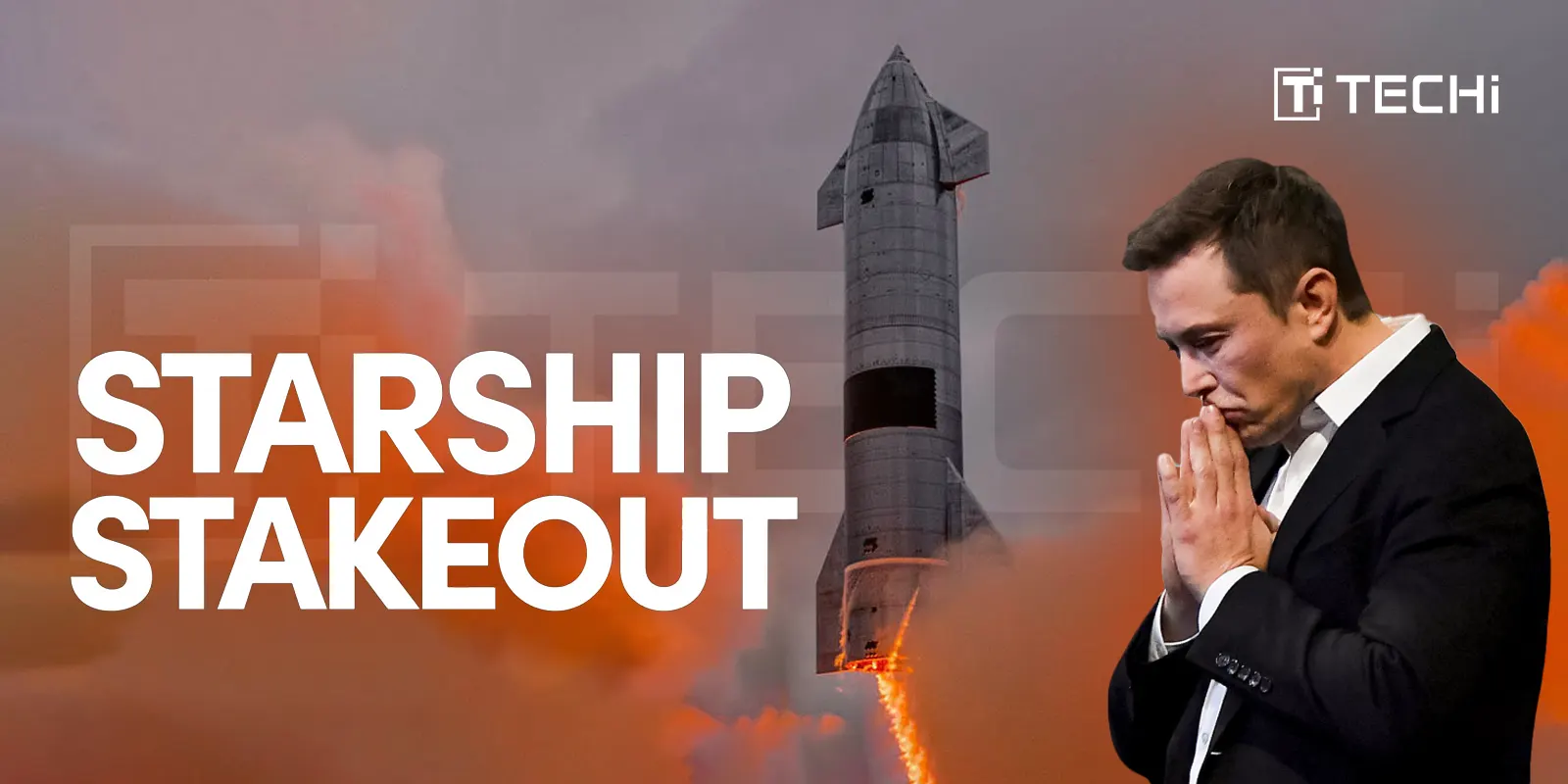
A back-to-back failure occurred as the 8th test flight of SpaceX’s starship ran into critical problems and eventually blasted after 8 minutes of launch. There were huge roars of celebration and success from an enthusiastic team for a successful takeoff while it was broadcast Live. The ship was safely separated and went into space, after which the super booster that propels the ship out to space successfully returned to its Texas tower.

There were happy claps and screams at the sight of Booster clinging back to its tower. After only a few minutes, the ship spiraled out of control. Engineers lost control of multiple engines, followed by a gigantic blast. The debris started coming back like a shower of meteoroids and shooting stars. Then, the Federal Aviation Administration had to take quick action to reduce the number of flights in major Florida airports.

SpaceX Starship explosion debris resembling a meteor shower in the night sky

The Shower of Shooting Stars, Posted by OPTeemyst. It was the second failure in a row, as the seventh test flight met the same fate. The FAA immediately asked for a mishap investigation, and they sprang into action, halting and diverting flights to avoid any accidents due to debris falling from space. SpaceX communications manager Dan Huot said during the broadcast,

“We just saw some engines go out. It looks like we are losing attitude control of the ship.” Later, he mentioned that “at this point, we have lost contact with the ship.”

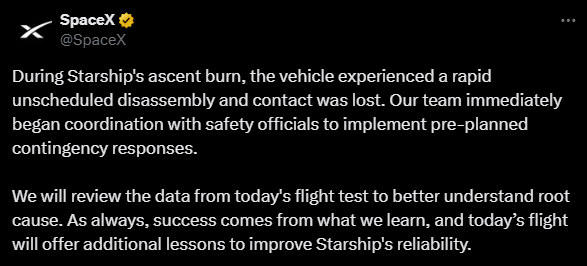
The ship exploded over the skies of the Bahamas and the Dominican Republic, and SpaceX had to post an immediate message on X that the vehicle experienced a rapid unscheduled disassembly and contact was lost. They are reviewing the data from this flight to understand the causes behind it. Given all that went wrong, SpaceX is an organization that never sits back, as the next test flight might already be on the cards.

SpaceX's official statement on Starship's explosion during ascent burn.

SpaceX has shared the complete launch video on their official site with explanations and experience. There were 6 Raptor engines in the ship, and they stopped responding one by one until a sonic boom was heard. Elon Musk has been caught in many controversies over the past few days, including losing a lawsuit against OpenAI for stopping it from becoming a for-profit entity. This is an additional shock after the 7th flight broke down during its January 16th, 2025 test run.

During this 7th test flight, engines experienced premature shutdowns and a complete loss of control. Roughly two to three minutes later, the vehicle disintegrated over the Turks and Caicos Islands, though no injuries were reported. That incident also resulted in airspace closures for over an hour, and the FAA had to call for a mishap investigation. After 7th test flight, the booster successfully returned to its Launchpad. The SpaceX team can celebrate and can again stay hopeful and proud for the 3rd booster return as well during the 8th test.

Scores of appreciation and public sentiments were expressed on the 8th test flight, and people praised the SpaceX team’s positivity and struggles.

Social media reactions to SpaceX's 8th Starship test flight

These tests are part of SpaceX’s mission of starting commercial flights into space, and SpaceX will continue to send the dummy versions of its Starlink satellites. They posted an investigation for their 7th test flight and changed several things to fix the previous issues, including improvements to the fuel system and the propellant. The company has always stayed very transparent in sharing the details of all its test flights and the glitches caught at any stage of the tests.

The 8 Starlink Flights’ Tests and Their Outcomes

Test # Date Launch Outcome Booster Landing Ship Landing Problems Positives
Test 1 April 20, 2023 Failure Failure Precluded Engine Failures within 4 min. Most powerful, heaviest rocket ever flown. Reached 39 km height.
Test 2 Nov 18, 2023 Failure Failure (Ocean) Precluded Leak in aft section during liquid oxygen venting, causing a combustion event that interrupted communication between the craft’s flight computers, leading to full engine shutdown. Reached 150 km altitude. Powerful show of all 33 Raptors working and a successful hot stage separation.
Test 3 March 14, 2023 Success Failure (Ocean) Failure (Ocean) Booster successfully propelled the spacecraft to staging, with 13 engines successfully ignited for a boostback burn, though 6 engines failed a few seconds before the end of the burn. Reached 462 meters in altitude and seven minutes into the mission. All Raptor engines started successfully and powered the vehicle to its expected orbit, becoming the first Starship to complete its full-duration ascent burn.
Test 4 June 6, 2024 Success Controlled (Ocean) Controlled (Ocean) Only one engine lost shortly after liftoff. Mission lasted for 1 hour and 6 minutes with a soft landing in the Indian Ocean. Executed first flip maneuver.
Test 5 Oct 13, 2024 Success Success (OLP A) Controlled (Ocean) The Booster RETURNED to LAUNCH Site. The greatest success ever achieved. Successful hot-staging separation, igniting its six Raptor engines and completing ascent into outer space.
Test 6 Nov 19, 2024 Success Controlled (Ocean) Controlled (Ocean) Second attempt at booster recovery. The ship completed in-space engine relight test and re-entered, splashing down in the Indian Ocean during daylight for the first time for any Starship.
Test 7 Jan 16, 2025 Failure Success (OLP A) Precluded Engines experienced premature shutdowns due to a propellant leak larger than the Ship’s systems could handle, followed by a total loss of telemetry. Vehicle exploded within 3 minutes. Booster successfully returned to its launch pad.
Test 8 Failure Success (OLP A) Precluded Engines lost after 8 min into the space. Booster successfully returned to its launch pad.

Elon Musk is a man on a mission. He is spending his energy and resources on these impactful technological developments. He has succeeded in many of his previous endeavors, and he has the guts to try one more time.

Musk Attempt to Stop OpenAI Transition into a for-Profit Entity Turned Down by Judge

Elon Musk co-founded Open AI and was a major financial contributor to it from 2015 to 2020, as per the lawsuit. Musk claims, the original vision of OpenAI was to work as a non-profit entity with no personal gain. When ChatGPT was launched, Sam Altman started commercializing the product with a monthly fee for its pro users. At that time, Musk advocated having a separate for-profit entity. However, differences emerged while finalizing the plan as Musk wanted majority shares. In 2018, Musk resigned from the OpenAI board after the company refused to attach OpenAI to Tesla.

In Feb 2024, Musk filed a lawsuit against OpenAI and its leadership. This was withdrawn in June 2024 and a new revived lawsuit was filed in August 2024. This lawsuit had several allegations. One of them was the transition to for-profit entity. Musk highlighted that OpenAI is deviating from the original plan of keeping OpenAI as a non-profit and their vision to serve the masses was not being accomplished.

The Judge, Yvonne Gonzalez Rogers, dismissed the for-profit allegation because Musk wasn’t able to provide any substantial evidence in favour of his allegation. While the attempt to block OpenAI’s transformation was denied, the border lawsuit remained active. The Judge has offered to expedite the trial process so that this case can be concluded early to avoid any harm to the business.

It should be remembered that Elon Musk was among the 11 co-founders, including Sam Altman and Greg Brockman. Musk invested more than 44 Million as per the lawsuit point 82 in OpenAI. We believe any organization that wants to be involved in technological advancements needs to be a for-profit entity to sustain the consistent technological advancements in AI. The operational costs of research and development are ever so high, and inconsistent government and investor policies can hamper the process.

This legal battle is like a personal feud between Elon Musk and Sam Altman. Musk has no open ground to stop OpenAI from operating as a for-profit entity. Judges claimed the same. It is interesting to note that just as recently as February 2025, Musk offered $97.4bn to take over OpenAI and preserve the AI research lab’s original mission. However, the board rejected the offer.

In an interview with Bloomberg, Sam Altman said this of Musk

“I think he is probably just trying to show us down, he obviously is a competitor, its you know he’s working hard and he has raised a lot of money for xAI and they are trying to compete with us from a technological perspective from you know getting the product into the market and I wish he would complete by building a better product but I think there’s been a lot of tactics, you know mana many lawsuits, all kind of crazy stuff and now this. And we will try to just put our head down and keep working”.

With stiff competition from several prominent companies like DeepSeek, Anthropic, Google DeepMind, Meta AI and a few others, this legal battle is not good for OpenAI. Sam Altman needs to keep a clear head and ensure the company is making progress to keep the competition at bay while going through this legal battle. At the moment, it seems like they are moving in the right direction. Altman tweeted

“we are likely going to roll out GPT-4.5 to the plus tier over a few days.” There is no perfect way to do this; we wanted to do it for everyone tomorrow, but it would have meant we had to launch with a very low rate limit. We think people are gonna use this a lot and love it.”

On the other hand, Musk needs to keep driving his xAI company forward. Competition is heating up, with the recent announcement that DeepSeek computing power costs only $6 million. AI is heading to an era where we will see lower computing costs, but at the same time, data is increasing by many folds. It is a challenge for AI companies to keep evolving and coming up with new techniques to keep their noses in front; otherwise, they will be left far behind in this global race.

Musk Starlink Battles Chinese Rivals in Fierce Satellite Internet Race

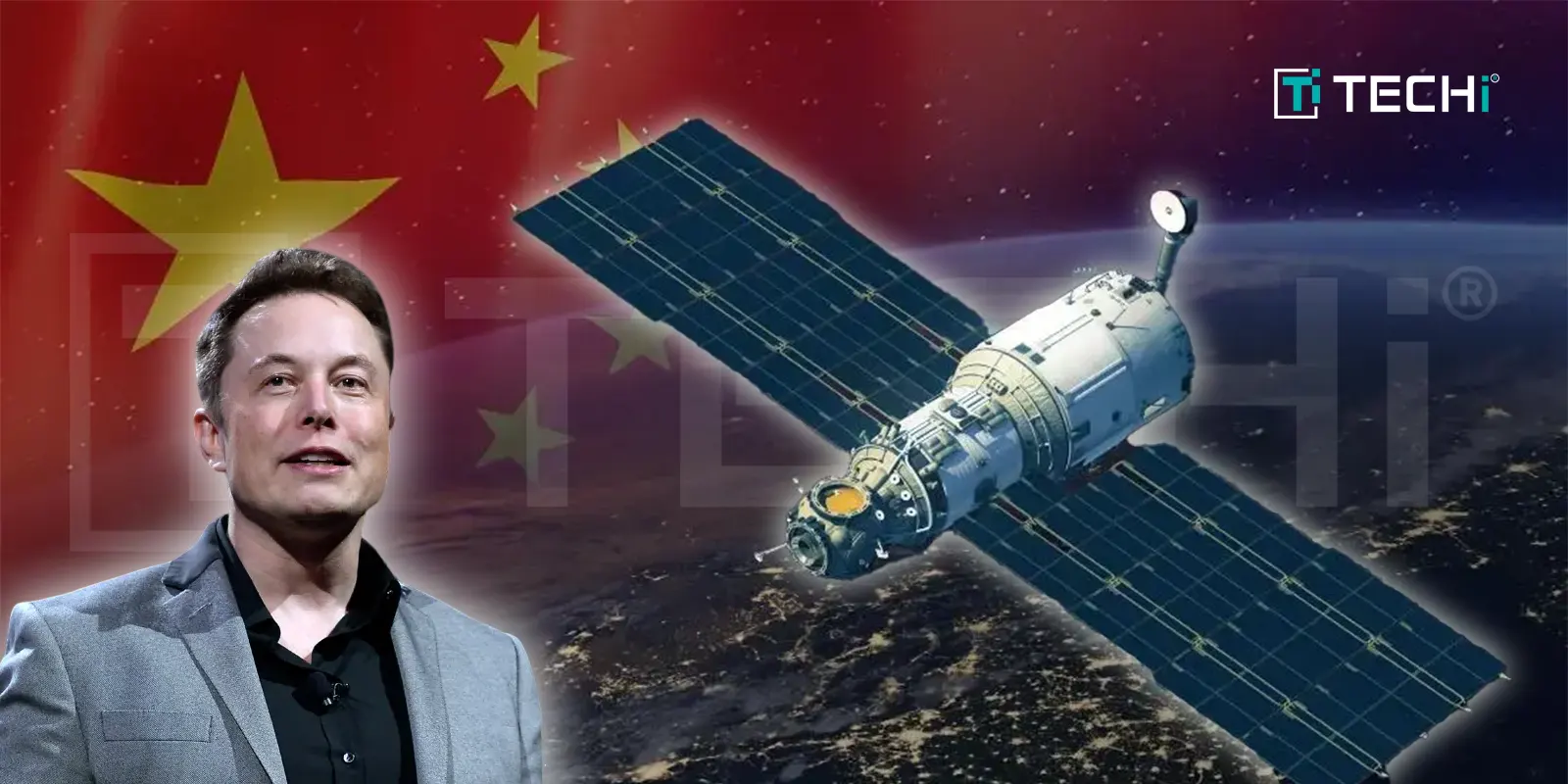
The industry finds itself in a new space-age contest between companies to provide internet to every corner of the Earth and not just plant its flags here or there. Musk’s Starlink was the only game in town with satellite broadband, but now it has come across stiff competitive forces from state-backed Chinese projects and rival billionaires. With thousands of satellites already in orbit and more on the way, the skies are getting pretty thick, and it has become a digital land grab where orbital real estate is the new gold.

With rising competition against Chinese state-backed initiatives and rival networks funded by tech giants such as Jeff Bezos’s Amazon, the satellite internet race is heating up against Musk’s Starlink. The battle for supremacy in Low-Earth orbit (LEO) satellite communications has been getting furious, with Chinese companies rapidly reaching out and snatching international concessions.

Chinese SpaceSail Takes over Global Stage:

Shanghai-based SpaceSail is becoming a strong contender against Starlink. In November 2024, it signed an agreement to enter the Brazilian market and shortly thereafter commenced operations in Kazakhstan as an indicator of its fast pace of expansion. Brasília is also entertaining talks with Bezos’s Project Kuiper and Canada’s Telesat, indicating a global shift away from monopolistic satellite internet providers.

Starlink has launched more LEO satellites since 2020 than all its competitors combined, now the challenge becomes more formidable with China’s massive invasions into space. These intrusions comprise heavy investments by the Chinese government in rival satellite networks and military research on Satellite constellation monitoring and tracking. 2023 saw China launching a record setting number of 263 LEO satellites, a new single year milestone of its growing aspirations.

Strategic Importance and Geopolitical Implications:

China’s push into satellite internet has been welcomed by some governments looking for alternative providers, particularly in those regions where Musk’s Starlink has been held up in political and commercial disputes. State owned or state controlled SpaceSail plans to establish a 648 Low Earth Orbit resident satellite system this year, with 15,000 satellites in orbit by 2030. A comparison shows that Starlink, with around 7,000 satellites actively working, aims to target a total of 42,000 by the end of this decade.

The Qianfan or “Thousand Sails” constellation is China’s first meaningful international effort in satellite broadband, with three additional ones under development. Meanwhile, Beijing is pursuing plans for several LEO satellites totaling 43,000 in forthcoming decades and is investing heavily in rocket technology to facilitate the efficient launching of satellites.

According to Chaitanya Giri, an Aerospace Technology expert with India’s Observer Research Foundation, “The endgame is to occupy as many orbital slots as possible.” In the view of many Western policymakers, this would moreover be a Chinese tool for extending its digital influence, of which the expansion of the Internet censorship procedure outside of China becomes a major point of concern.

Military and Economic Interests:

Space technology and geopolitics are intertwined through China’s greater race for the establishment of treaties on LEO satellite networks. The American Foreign Policy Council (AFPC) expresses fears that China’s foray into digital dominance through space infrastructure is an essential leg of its Belt and Road Initiative (BRI), a $1 trillion undertaking deeply criticized as a tool of geopolitical development.

Chinese military research institutions, including the National University of Defense Technology, are also deeply engaged in researching satellite constellations. State backed companies such as HongQing Technology are receiving a considerable amount of investments, the recent 340 million yuan funding round was largely supported by state affiliated investors. Meanwhile, SpaceSail raised 6.7 billion yuan (US$930 million) in a funding round led by a state owned fund to develop China’s manufacturing capabilities.

Increased satellite related rights reflect China’s determination to bridge the technology gap. In 2023, the country published an unprecedented 2,449 patents on LEO satellite technology, as compared to just 162 in 2019. Many of these are directed toward cheap satellite networks and low latency communication systems that are essential to ensure China’s competitiveness.

Military Utility of Starlink and Counterstrategies from China:

Starlink, developed by Musk, has been part of military actions since Ukraine as being aligned with military operations. Growing worries in China have translated into more state funding for Chinese alternatives. Chinese scientists are very interested in decoding Starlink’s satellite network. They recently had a study from two PLA-affiliated institutes suggesting that it invented a crazy tracking system inspired by how whales encircle and trap their prey using spiraling bubbles. The necessity of tools such as monitoring mega constellations like Starlink has been stressed due to increasing militarization trends in space.

Satellite internet is still one of the fast-moving frontiers, with early movers defining the pace and nature of things before the tightening of regulatory frameworks. Thus, Antoine Grenier, the Global Head of Space at Analysys Mason, said, “The space world is moving fast and busy experimenting. Pioneers are enjoying this relative freedom and are shaping it to their advantage to claim key positions before rules become more stringent—like the Wild West.

Furthermore, the researchers wrote that, “With the growing trend of space militarization, developing tools to monitor and track these megaconstellations is critically important”. The market that Starlink had once dominated is quickly shifting toward the current, all-out lean from China into the LEO Satellite. Musk’s Starlink is facing its greatest test amid an aggressive Chinese expansion. What will result from that remains to be seen, such as whether enhanced internet connectivity reaches distant communities or increases geopolitical contention. 

Read More: Alibaba Surpasses a Decade of AI Investment with its $52 Billion in AI and Cloud Computing

X Blocks Signal Links – A Threat to Digital Freedom and Privacy?

X (formerly Twitter) has ignited controversy by blocking links to Signal.me, a domain linked to the widely used encrypted messaging app Signal. Users attempting to share these links are met with error messages suggesting they are spam or potentially harmful. However, links to Signal.org remain unaffected, leading to concerns that this selective restriction is an intentional move against encrypted communication rather than a broad moderation policy.

Why Is X Targeting Signal?

Signal has built a reputation as a go-to app for private messaging, relied upon by activists, journalists, and government officials seeking secure conversations. The app’s end-to-end encryption makes it an essential tool in an era where digital surveillance is an increasing concern.

Cybersecurity expert Matthew Green, a cryptography professor at Johns Hopkins University, expressed skepticism about X’s justification for blocking Signal links: “Blocking Signal links under the guise of ‘spam prevention’ is highly suspect. It’s hard not to see this as an attempt to make secure communication harder for people who rely on it.”

This move comes amid X’s history of restricting links to competing platforms like Facebook, Instagram, and Mastodon. However, Signal is not a direct competitor to X—it’s a private communication tool, not a social networking platform. So why would X take issue with Signal?

A Crackdown on Whistleblowers?

Some analysts believe this could be part of a broader effort to limit whistleblower activity, particularly among federal employees who have been increasingly using Signal to communicate privately about internal government matters. Reports indicate that employees in various agencies, including those under Elon Musk’s oversight, have turned to Signal to discuss concerns regarding internal policies, inefficiencies, and alleged misconduct.

Musk has previously hinted at developing his own encrypted messaging service within X, leading some to speculate whether this move is intended to direct users toward X’s own proprietary communication tools instead of an independent and secure platform like Signal.

What’s Next for Digital Privacy?

X Blocks Signal Links a worrying shift in digital communication policies. If X can arbitrarily suppress access to privacy-focused tools, what’s stopping other platforms from doing the same? Social media platforms have evolved into public communication spaces, and restricting encrypted messaging services could have widespread implications for journalists, activists, and privacy-conscious individuals.

For now, X has not officially commented on whether this block is intentional or a technical oversight. Users looking to share their Signal contacts will have to resort to workarounds, such as sharing usernames directly. However, the lack of transparency raises an important question.

Read More: Elon Musk’s AI Revolution Continues as xAI Unveils Grok 3 AI Model

Trump Fires FAA Workforce as Musk’s SpaceX Enters Air Traffic Control

“You are fired!” seems to be apparently the new in-flight announcement. As Commercial aviation is the art of balancing both technological precision along with human expertise, what happens when one end of the equation is suddenly compromised overnight? The most recent mass firings at the Federal Aviation Administration (FAA), which have taken place alongside the introduction of yet an undefined role for SpaceX in the future of air traffic control, have raised eyebrows, sparked debates, and left a lot of people wondering if the skies have suddenly perhaps became a bit more turbulent. 

According to a CNN source, the Trump administration has dismissed hundreds of Federal Aviation Administration (FAA) employees assigned to critical air traffic control infrastructure. The terminations began late Friday night, just as SpaceX, under Elon Musk, was contracted to assist with developing an entirely new air traffic control system.

Mass Firings:

The number of affected workers is still unknown. However, the union representing the employees, the Professional Aviation Safety Specialists (PASS), noted that among them were mainly terminations due to probationary employees. These were newly hired employees who had yet to complete at least a year of duty since employment. Notably, these are not air traffic controllers, as the sector is already plagued by a shortage of staff due to resignations and retirements.

As reported by Dave Spero, president of PASS, “the employees were fired without cause nor based on performance or conduct. The emails didn’t come from a government email address; they came from an exec order Microsoft email address”. These employees belonged to professionals whose work includes maintenance on FAA radar equipment, landing systems, and navigation aids. An anonymous air traffic controller disclosed to the Associated Press that the layoff also affected aircraft certification specialists, aviation technical system experts, engineers, architects, and flight procedures teams. Galen Munroe, Deputy Director of Public Affairs at the National Air Traffic Controllers Association (NATCA), confirmed that the layoffs reached across several essential aviation safety roles.

Safety Concerns:

Congress has been pushing for years for the FAA to deal with the systemic problems posed by recurring near-misses and the modernization of its infrastructure. In spite of alarm bells rung by aviation experts, the agency has been negligent in facilitating any of the most needed safety upgrades.

This wave of firings follows a crash that occurred over Washington National Airport this January. A single controller was responsible for helicopter and commercial airline traffic at the heavily trafficked airport, and several other aviation accidents have followed since. Nick Daniels, President of NATCA, said, “We will analyze the effect of these terminations on aviation safety and the national airspace system. It’s a sad day for those who chose to serve in aviation safety and public service, only to have their careers cut short.”

SpaceX and the Future of Air Traffic Control:

Just days after the Washington D.C crash, Musk took to X (formerly Twitter) to announce that Trump’s Department of Government Efficiency (DOGE) had approved efforts to “make rapid safety upgrades to the air traffic control system.” However, there have been no further details made available by either Trump or Musk on the expected upgrades.

Secretary of Transportation Sean Duffy posted on X that, “On Monday, members of Musk’s SpaceX team were at the Air Traffic Control System Command Center in Virginia. The purpose of the visit was to allow SpaceX to get a firsthand look at the current system, learn what air traffic controllers like and dislike about their current tools, and envision how we can make a new, better, modern, and safer system.”

While it seems that SpaceX may have added modernizing air traffic control to their portfolio, recent mass firings raise a lot of concerns regarding immediate risks to safety and disruption to air traffic operations. The involvement of SpaceX introduces uncertainty but also excitement for the future of air traffic control which could lead either to innovations or to turbulence. For now, travelers and industry experts alike will keep their seatbelts fastened and tray tables locked, watching closely to see if this new trajectory opens up with a clear sky or causes another chaos. While the implications of such a decision are being debated by various industry experts and policymakers, the future of American air traffic control seems far from certain. 

Read More: Elon Musk’s AI Revolution Continues as xAI Unveils Grok 3 AI Model

Elon Musk’s AI Revolution Continues as xAI Unveils Grok 3 AI Model

Artificial intelligence has evolved rapidly along with xAI certainly taking up the challenge with the launch of Grok 3 AI Model that promises advanced reasoning capabilities, deep search, and a voice mode, making it the most intelligent chatbot around. Although, in the current super competitive AI race, one question is raised in people’s minds, will Grok 3 outwit, outlast, and out-GPT its competitors?

The xAI’s Grok 3, founded by Elon Musk, became the latest flagship AI model launched, with new features being introduced in Grok apps on iOS and the Web. It is designed to compete with OpenAIs’ models GPT-4o or Google ‎Gemini. Grok 3 has extensive capabilities in image analysis, reasoning, and deep research functions, categorically establishing an AI performance benchmark.

Grok 3 AI Model step ahead in AI:

Grok 3 AI Model had reportedly been under development for a few months and was in need of massive training in a data center in Memphis with nearly 200,000 GPUs. Musk in his post on X claimed that, “Grok 3 was developed with 10x more computing than Grok 2, its predecessor, and with an expanded training data set that ostensibly includes filings from court cases”.

During a live-streamed presentation Musk said, “Grok 3 is an order of magnitude more capable than Grok 2. [It’s a] maximally truth-seeking AI, even if that truth is sometimes at odds with what is politically correct”. Grok 3 is not one model, but rather a family of models, including the Grok 3 mini, which works faster but with less accuracy. Not all features are available right away but the launch has started this Monday.

Performance and Benchmarks:

According to xAI, Grok 3 surpasses GPT-4o in major AI benchmarks, including American Invitational Mathematics Examination (AIME) (resolution of mathematically inclined questions) and Graduate-Level Google-Proof Q&A Benchmark (GPQA). Early on, Grok 3 was found to compete with others in the Chatbot Arena, which is a crowdsourced platform to assess AI performances.

Grok 3 also has two special variants, Grok 3 reasoning and Grok 3 mini reasoning, in contrast to OpenAI o3-mini and DeepSeek R1 models in certain problem solving tasks. Whereas these reasoning models are working on a deep self-verification path before delivering their answers, thereby significantly increasing the level of correctness on mathematical, scientific, and programming questions. xAI claims Grok 3 Reasoning is better than OpenAI’s leading o3-mini-high model for mathematics, especially for AIME 2025. Users can interact with these models from the Grok app, using Think mode for general reasoning or Big Brain mode for complex computations requiring additional processing.

DeepSearch and Subscription Plans:

Reasoning in Grok 3 is also present in DeepSearch, an AI powered research tool by xAI where the internet and X delivers complete analyses. DeepSearch is xAI’s answer to similar tools from OpenAI and other AI firms. Access to Grok 3 is first limited to subscribers of X Premium+ plan, which costs $22 per month. Meanwhile, an upgraded subscription tier, SuperGrok, is rumored to cost $30 per month or $300 per year, offering additional reasoning queries, DeepSearch capabilities, and unlimited image generation. Musk also announced that Grok 3 will soon gain a voice mode, enhancing user interaction with synthesized speech.

Within weeks, Grok 3 models will be available in xAI’s enterprise API alongside DeepSearch functionality. Additionally, Musk revealed plans to open source Grok-2 in the coming months, stating that, “Our general approach is that we will open-source the last version [of Grok] when the next version is fully out. When Grok 3 is mature and stable, which is probably within a few months, then we’ll open-source Grok 2.”

Political Controversy:

Musk originally pitched Grok as being a way for people to get away from mainstream AIs, promising it would be “edgy, unfiltered, and anti-woke.” In previous versions, however, Grok could not resist becoming politically sensitive or aligning with leftist views prevailing in most social issues. Musk attributed that to Grok’s training data and promised to change its tone toward political neutrality.

Whether Grok 3 will achieve that remains to be seen, as well as how its stance on “truth-seeking” AI will be able to shape public discourse and governance over AI. It’s a milestone in the changing AI landscape, and this latest release from xAI promises to stretch what AI models are capable of. How far Grok 3 will go in terms of its perceived capabilities remains to be seen, while Musk continues to pursue the population of AI with truth seeking.

Read More: Apple Maps May Introduce Google-Style Ads to Expand Its Revenue Stream

Elon Musk Announces Live Demonstration of Grok 3 AI Chatbot

Tech billionaire Elon Musk has announced that Grok 3, the latest iteration of xAI’s artificial intelligence chatbot, will be officially unveiled in a live demonstration on Monday at 8 p.m. Pacific Time (0400 GMT on Tuesday). Musk’s xAI, positioned as a competitor to OpenAI, has been developing Grok 3 as an advanced AI chatbot aimed at rivaling the capabilities of ChatGPT and other leading AI models.

Grok 3 in Final Stages of Development 

Earlier this week, Musk announced that Grok 3 was nearing completion and that its launch was expected within one to two weeks. This announcement aligns with Musk’s ongoing efforts to expand xAI’s role in the AI sector, following the introduction of earlier Grok models, which were integrated into his social media platform, X (formerly Twitter).

Musk Claims Grok 3 Outperforms Existing AI Models 

Musk has been vocal about Grok 3’s capabilities, hinting at significant improvements in reasoning and language understanding. While no official benchmarks have been released, he suggested that Grok 3 has demonstrated superior performance compared to existing chatbots in internal tests. This launch is expected to be a critical moment for xAI as it attempts to establish itself in the increasingly competitive AI race, currently dominated by OpenAI, Google DeepMind, and Anthropic.

xAI in Talks for $10 Billion Investment 

Beyond the Grok 3 release, reports indicate that xAI is in discussions to secure up to $10 billion in funding, potentially valuing the company at $75 billion. If successful, this would further solidify xAI’s position as a major player in the AI industry, providing the necessary resources to scale its technology and infrastructure.

 What to Expect from the Grok 3 Launch? 

The live demonstration of Grok 3 will likely showcase real-time AI interactions, emphasizing improvements in contextual understanding, speed, and reasoning abilities. Industry experts and AI enthusiasts will be watching closely to see how Grok 3 stacks up against ChatGPT and Google Gemini. With the AI landscape evolving rapidly, Musk’s xAI is aiming to disrupt the market by delivering a more advanced, responsive, and intuitive AI assistant. Whether Grok 3 lives up to the hype remains to be seen, but one thing is certain—the competition in AI innovation is intensifying.

Read More: Google’s Most Advanced AI Model Gemini 2.0 Now Available for Everyone

Elon Musk’s Battle to Buy OpenAI, Five Crucial Insights from His Offer Letter

In the life of tech billionaires, the drama tends to arise sooner than a software update. Musk’s next move is all about bidding to the tune of nearly $97 billion to reclaim OpenAI, a company he once championed but is now suing. While OpenAI CEO, Sam Altman brushed his offer aside, the court filings reveal Musk’s detailed offer to tell the whole saga, including lawsuits, power wrangling, and strategic chess moves that have entangled two of the most powerful names in the AI Industry.

An investment syndicate led by Elon Musk’s xAI has proposed an unlikely offer of $97.4 billion to acquire OpenAI. Altman has anyway very quickly declared the offer as impossible because it is seen as a method to block OpenAI from making nonprofit transition, an action in which Musk is also challenging with his own suit. In a legal filing on Wednesday, Altman’s team argued that Musk’s position is contradictory, attempting to buy the assets of OpenAI while also trying to prevent its conversion to nonprofit.

Musk’s team countered that they would withdraw the offer if OpenAI’s efforts to move away from its nonprofit status ceased. Musk’s entire letter of intent to buy open AI was published as part of this legal turmoil, this opened up a broader understanding of his plan and motivation.

The five key details from Musk’s Offer Letter are following;

1. Deadline for the Offer:

A definite expiration date for May 10, 2025, is that of the unsolicited bid by Musk’s consortium. It goes off the track only if the parties to the interests finalize the deal, or they mutually decide to terminate discussions, or if OpenAI explicitly rejects the offer in writing.

Altman has publicly dismissed such offers (including a humorous counter offer to buy X at tenth of the price) but OpenAI has yet to issue an official rejection statement. Even offers between competitors must get consideration before being outright dismissed due to legal requirements.

2. Cash Transaction:

Musk’s financing group with notable venture capitalists like Joe Lonsdale’s 8VC and SpaceX investor Vy Capital has offered just $97.375 billion in cash. This is because, in the past, he has borrowed money to finance such acquisitions, like the $13 billion borrowed from banks to acquire twitter in 2022, and though self-proclaimed as having a fortune of about $400 billion, mostly raised by a boost from Donald Trump, it was not disqualified from consideration. Interestingly, the letter mentions seven investors, including Musk’s x.AI, alongside others unnamed, implying that Musk is not relying solely upon his wealth to finance the deal.

3. Access to all Financial and Operational Data:

The consortium of Musk demands full access to OpenAI’s financial records, assets, employees, and business operations before it commits a ginormous buy. “Assets, facilities, equipment, books, and records” is mentioned in the letter to indicate such needs.

This stress has indeed been caused, given that the said due diligence is normal in major transactions for such things, as making an acquisition review that is much more compelling opens it up to very internal and state of the art sensitive knowledge that might be a possible conflict of interest based on xAI’s having a direct market competitive claim in OpenAI to gain such level of access.

4. Undermining Musk’s Lawsuit:

Musk’s legal battle against OpenAI revolves around his contention that OpenAI’s assets can never be “transferred away” for private gain. However, in a filing on Wednesday, the lawyers for OpenAI pointed out that Musk’s offer contradicts this claim and emphasized that he is making an offer to dispose of an acquisition effort just to weaken a competitor. They said, “The offer isn’t serious, but an improper bid to undermine a competitor.”

According to OpenAI, the offer is not genuine and was strategically timed to complicate its privatization. Musk’s camp insisted otherwise, claiming that the bid was legitimate and that funding would be funneled straight into OpenAI’s nonprofit purpose.

5. Musk’s withdrawal from the offer:

Musk’s legal team stated that if the board of OpenAI decides not to convert into non-profit operation, he would withdraw the offer. More speculation would be reinforced with this statement that Musk’s bid was not aimed at buying OpenAI altogether but only bumping up the figure that would make Altman and other top executives acquire the company privately.

OpenAI board legal representative dismissed such an offer from Musk and said, “Musk’s bid doesn’t set a value for [OpenAI’s] non-profit and that the nonprofit is not for sale”.

The Repercussions:

This adds to the already complicated legal and financial drama over OpenAI, which is still far from being resolved. The rejection of the bid from OpenAI would give Musk the further ground to challenge the legitimacy of its nonprofit conversion. On the other hand, if OpenAI accepts or considers the offer, it risks getting into trouble over its governance. Either way, whether Musk’s offer is a genuine attempt to acquire OpenAI or just a tactic within his legal showdown, it has put OpenAI in a difficult position.

Truly, one wonders, whether the billionaire indeed wants to acquire OpenAI or is using the bid as a bluff or a feint to disrupt its transition into nonprofit status. Well, one thing is clear, it isn’t merely a corporate dispute rather it’s the critical moment of evolution regarding what artificial intelligence is and what big tech makes it into in the future. As both continue their game of legal and financial chess, the world waits to see who blinks first.

Read More: OpenAI Drops o3 AI Model to Unify AI Strategy with Game-Changing GPT-5
Elon Musk’s $97.4B Bid for OpenAI Sparks Controversy and Industry Shockwaves

Artificial intelligence is on its way to an advanced level day by day. Speaking of advanced, there can be none more audacious than Musk’s new initiative. He is making an incredulous $97.4 billion bid for OpenAI. This stirred up the tech industry with shock waves and the rest of the tech world is understandably confused, seeing as how OpenAI’s board states that it has not received a formal offer.

The feud between Elon Musk and OpenAI has taken another turn this week, as sources reveal the OpenAI board has yet to receive a formal takeover offer by the billionaire consortium. However, Musk’s lawyers assert that the offer was sent, and OpenAI stands firm that the nonprofit operating ChatGPT is not for sale.

The Bid:

The day after Musk publicly made his offer of $97.4 billion to buy OpenAI, doubts remained as to whether the board has even seen it or not. An anonymous source close to the situation alleged that OpenAI’s board has not received a formal offer, contradicting claims made by Musk’s attorney, Marc Toberoff. Toberoff asserts that a bid in the form of a four-page Letter of Intent was sent via email to OpenAI’s outside counsel at Wachtell, Lipton, Rosen & Katz. The law firm, however, has yet to confirm or deny receipt of the document. Toberoff said, “The bid – attached to an email – was in the form of a detailed four-page Letter of Intent to purchase OpenAI’s assets, signed by Musk and other investors and addressed to the board”. He further emphasized, referring to OpenAI’s CEO, “Whether Sam Altman chose to provide or withhold this from OpenAI’s other Board members is outside of our control”.

OpenAI CEO Sam Altman fiercely refuted Musk’s proposal. Addressing the audience at an AI summit in Paris, Altman dismissed the bid as “ridiculous,” arguing that OpenAI’s nonprofit side is not for sale. Altman said, referring to Musk, “The Company is not for sale. It’s another one of his tactics to try to mess with us”. This suggested that Musk’s bid was more for disruption than legitimate acquisition.

OpenAI’s Transformation:

Co-organized by Musk, OpenAI was inaugurated in 2015, a non-profit with the mission of being engaged in enlightened development of AI. Musk parted ways from the company because of disagreement over the vision and funding mechanisms. Since then, OpenAI has grown into one of the most prestigious destinations in AI, raising billions in its for-profit transformation.

OpenAI now finds itself in a maze of legal and regulatory cobwebs as it seeks to raise $40 billion while moving from the status of a non-profit to a capped-profit one. The attorney general of Delaware, Kathy Jennings, is looking into whether or not OpenAI’s transformation into a profit-oriented organization fits the aim for charitable operation it was designed for, thus preventing the current leadership from pursuing commercial objectives instead of benefitting the general public. She said, “I am reviewing OpenAI’s proposed changes to ensure the company is adhering to its specific charitable purposes for the benefit of the public beneficiaries, as opposed to the commercial or private interests of OpenAI’s directors or partners.”

Meanwhile, Musk’s startup is establishing its own AI project through promoting xAI as a competitor to OpenAI. The recent attempt to acquire OpenAI now throws a wrench into ongoing discussions on OpenAI’s valuation and fair market value for assets held by the nonprofit.

Challenges and Market Implications:

Legal experts remained certain that Musk’s offer would indirectly create an asset price for OpenAI’s nonprofit status. Robert Weissman, Co-President of consumer rights group, Public Citizen, pointed out that regulators would be obliged to ensure that any dismantling of these assets takes place at fair market value should OpenAI’s nonprofit entity decide to obtain control of the process. Weissman said, “It does help set a price point for the thinking about the valuation of the nonprofit assets. If it were to occur as proposed, the regulators have a duty to ensure that if there’s a selloff of assets to a for-profit entity, that fair market value is obtained.”

In the meantime, amidst the present volatility, OpenAI is put in a situation to get funding for financing and push AI research forward. Right now, Altman’s message to Musk is definitely no offers whatsoever for the purchase of OpenAI, regardless of whatever price it puts on the table.

Musk sees himself as the rightful steward of AI’s future, while OpenAI stands firm on independence and funding for future progress. Whether this standoff escalates into legal battles, under regulatory scrutiny, or with another surprising turn remains to be seen. One thing is for sure, the future of AI is equally about corporate power plays as technological breakthroughs.

Read More: OpenAI Hunts for U.S. Sites to Build Trump-Backed ‘Stargate’ AI Superhub

Musk’s Legal Battle with OpenAI May Head to Trial, Judge Rules

A federal judge in California has ruled the sections of  Musk’s lawsuit will proceed to trials, requiring his testimony. On Tuesday, a judge said that portions of  Elon Musk’s case against OpenAI to stop its conversion to a for-profit-entity will proceed to trial. He also added that Tesla CEO will also appear in court for testimony,

“ Something is going to trial in this case,” District Judge Yvonne Gonzalez Rogers in Oakland, California, said in the early court session. 

Musk will sit on the stand and present his point to a jury, and a jury will decide who is on the right side. 

District judge Rogers was considering Musk’s recent request for a preliminary injunction to block the conversions generated by OpenAI before going to trial. Thus, the latest move in this battle is between the world’s richest person and CEO of OpenAI, Sam Altman, who is playing publicly. 

The last time Rogers was given a preliminary injunction was in Epic Games’ case against Apple in  May,2021. 

Musk has also been the Cofounder of OpenAi with Altman in 2015, but quit before the company took over and started the competing AI startup xAI in 2023. OpenAI is now shifting to a for-profit entity from nonprofit one, which clearly exhibits its need to generate a secure revenue for best AI models development

Last year, Musk filed a case against OpenAI and Sam Altman, saying that OpenAI founders approached him to fund a nonprofit AI development for humanity, but their focus is on making money. He later expanded the case to federal antitrust for more claims, and in December asked the judge presiding over the lawsuit to refrain AI from transitioning into a for-profit. 

In response to this filed case of Musk, Open AI has recorded their word, saying that the claims of Musks should be dismissed and that Musk “ should be competing in the market rather than the courtroom” 

The stakes on OpenAI’s transition has now moved after their last fundraising of around $6.6 billion with a new roundup of $25 billion under discussion with softbank are conditioned on the company restructuring to remove the non-profit entity’s control. 

Such reinstatement of AI would be a bit  unusual, said Rose Chan Loui, executive director of the UCLA law center for Philanthropy &  nonprofit entities. The shift of nonprofit work to for-profit has historically been for healthcare organizations like hospitals, not venture capital-backed organizations, she said. 

Read More: OpenAI Seals Partnership with Kakao

USAID is “Beyond Repair”, Musk Claims He’s Working to Shut it Down 

Elon Musk’s latest outburst has him launching his usual $600 missile straight into USAID (metaphorically), which he declared “beyond repair” and is keen upon abolishing it. For Musk, after space travel, electric cars, and media, it just makes sense that he would become a part of cutting government waste and add it to the list. Backed by Trump, Musk’s latest entry has frankly raised eyebrows and had some discussions over this more than a little confusion.

Is it efficient? Or just another episode in the ceaselessly revolving door of the political circus? Billionaire Elon Musk revealed on X about shutting down the United States Agency for International Development. Musk was appointed to lead a federal cost-cutting initiative by U.S. President Donald Trump, where he went on to say USAID is beyond repair and confirmed the closure with Trump.

Musk’s Controversial Growing Role:

The USAID, being the largest single donor in the world, spent $72 billion in the year 2023, with regard to humanitarian assistance, health, anti-corruption, energy and security around the world. It gave 42% of all humanitarian aid which was tracked by the United Nations for 2024. Although within the framework defined by Trump’s “America first” policy, most of the U.S. foreign aid remains frozen, putting programs such as clearing landmines, field hospitals, and HIV/AIDS treatment at risk.

Musk, who also serves as CEO of Tesla and SpaceX, has been given a respectable position in the Trump administration to lead DOGE, a newly created Department of Government Efficiency. His work has raised worries, especially since revelations emerged that his team had acquired access to sensitive government systems like the Treasury payment system, which is responsible for processing more than $6 trillion per annum.

Cost-Cutting Scheme and Political Response:

According to Musk, the Trump administration can save $1 trillion from the deficit for the following year through the elimination of waste and fraud. He specifically alleged that “professional foreign fraud rings” obtain huge amounts of U.S. money by creating fake digital identities. However, no evidence was put forth by Musk in support of these allegations. Senator Peter Welch, a Democrat from the Senate Finance Committee, has initiated an investigation regarding the access granted to Musk over the Treasury system with allegations of the security of taxpayer data.

Welch said, “It’s a gross abuse of power by an unelected bureaucrat and it shows money can buy power in the Trump White House,” Despite the condemnation coming from the Democrats and the so-called progressives, Trump openly declared his support for Musk as a “big cost-cutter” for having streamlined the government and is not worried, as there will be times when they just don’t see eye to eye. Trump said, “He’s a big cost-cutter. Sometimes we won’t agree with it and we’ll not go where he wants to go but I think he’s doing a great job. He’s a smart guy, very smart and he’s very much into cutting the budget of our federal budget.

Musk has been rapidly expanding influence inside the administration. Undoubtedly ever since his vow, Trump has made the most unusual of drastic measures toward putting this government into his own design by firing and sidelining hundreds of bureaucrats and appointing loyalists to strategic positions. The shake-up indicates that U.S. governance is undergoing a radical transformation, with Musk at the center of a controversial operation to take down federal agencies and redefine the parameters of government intervention.

Read More: Elon Musk Reportedly Exerts Influence Over U.S. Government Agencies