The Social Media Monster

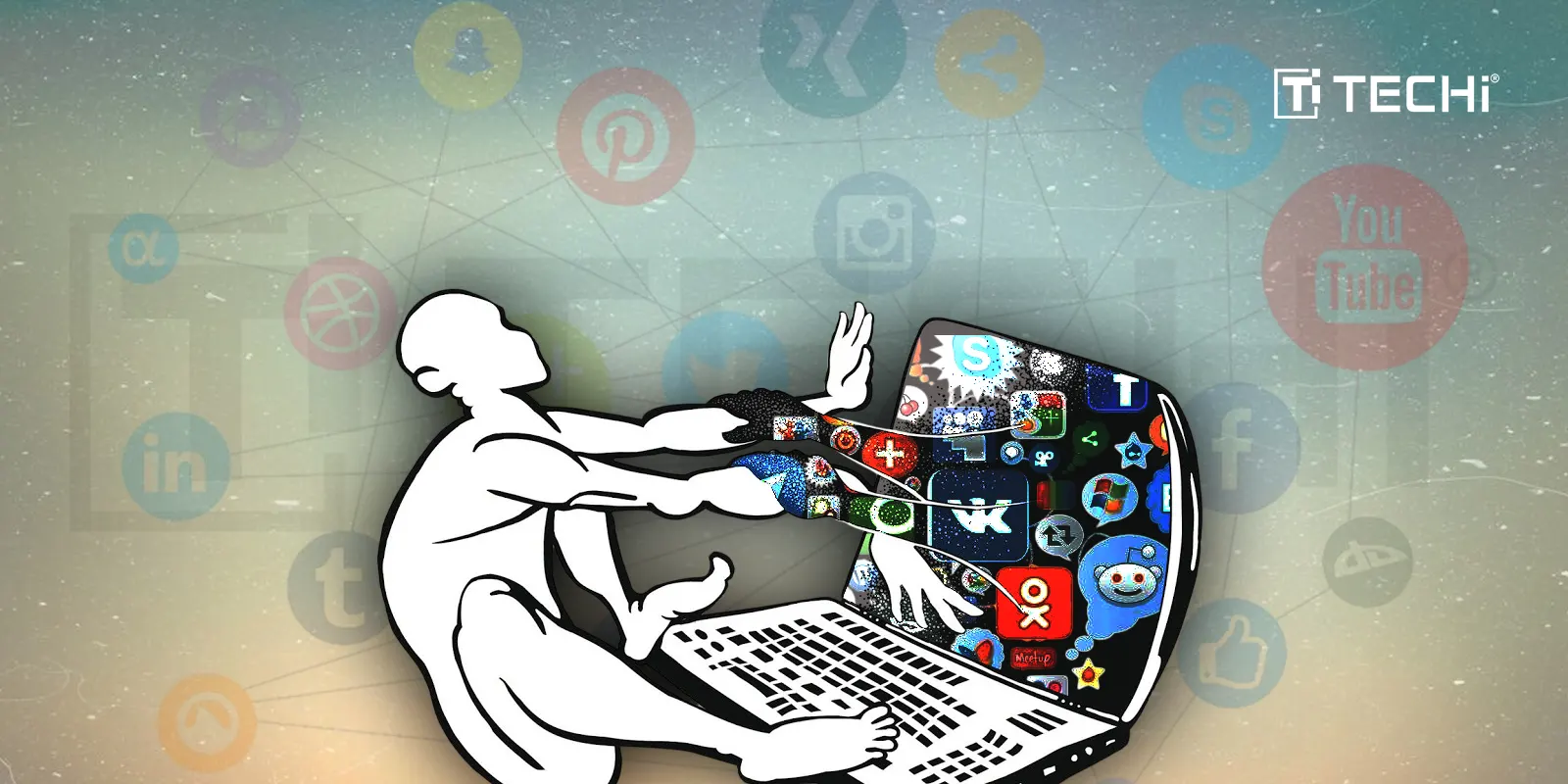
The monster never sleeps, never stops watching, and never lets go. It whispers in your ear the moment you wake up and follows you wherever you go. As you eventually bow your head for sleep, it lulls you into its incorporation. You welcome it instead of fearing it. You allocate your time, thoughts, emotions to it. It rewards you with an endless craving for approval and allows you to be positively shaped by it. That is no horror story; it is the social monster we birthed and have become ever so reckless in controlling.

From a simple tool for connecting friends, it has metamorphosed into something much bigger, much worse, holding innumerable puppet strings over how we think, feel, and perceive ourselves. It does not exist solely on phones; it lives in our minds. And like Frankenstein’s wretched creation, this one too has somehow freed itself from its maker’s control-and now, expects dominion over us.

An honest dictionary definition presents social media as “websites and apps that allow people to share content and connect with others.” But could that be the only limited definition? Sure, it can do so and so much more; in fact, it sees you all the time, like the all-seeing eye Orwell describes in his 1984. It sees everything you do, infers your wants, and manipulates your decisions. It controls you first before connecting you.

Where Does It Take Us in Terms of Loneliness?

How could social media, the supposed bridge among us, increase feelings of solitude? In so many different ways, Facebook, Instagram, Twitter, and TikTok all help people communicate, but they also sow the seeds of anxiety, cyberbullying, and aspirations that are not attainable. People pursue an illusion of happiness, like Jay Gatsby in The Great Gatsby, online and offline, because seeing perfect lives on social media makes them feel like accepting nothing less.

Why Do We Favor Comparison?

The finding shows that social media itself induces anxiety and depression if overused. Have you ever found an occasion scrolling posts when your own life fell short? The perfect photos, fun trips, and lovely relationships we see online can solidify our perception that we are just not good enough. But is what we see on social media true? These platforms want to engage us, comparing ourselves with one another and just keep longing for more.

Can We Break Free from the Chains of Social Media?

Jeffrey Cohen in Monster Culture mentions, “The monster theory must therefore concern itself with cultural moments that always oscillate, that change and that ultimately escape.” Social media has moved from mere technology to one huge beast influencing culture.

How Do We Fight Back? But how do we fight back? Like Odysseus resisting the Sirens’ song in The Odyssey, we are not entirely powerless. He who rules is He who can be ruled. Setting limits on time spent away, following only certain things, and consciously clearing the mind from the influence of social media can help in letting go of it. Social media is a monster-a monster that we created. Will we dominate it, or will it?

The Unseen Monster, How Social Media Traps Us

You carry it everywhere with you; you reach for it without thinking; you feel out of sorts without it. Social media, once a lifestyle, is now an addiction, an invisible monster that stalks you wherever you go. It has no claws to grab you and no fangs to bite you, yet it controls you. With the smirk of an unseen devil, it forebodes evil upon your soul concerning what to see, what to feel, and what to want.

Among the wicked strain of its arsenal is the false sense of having a perfect life. While scrolling through the social media feeds, you are mesmerized with nice holidays, fancy dinners, perfect selfies, and numerous party celebrations. But has there ever been a moment of questioning:

Is there a shred of truth to it?

Most of it happened under the stage camera with the glamour aspect added to it; it keeps you asking, WHY ISN’T MY LIFE LIKE THIS? This is a success for social media: creating unrealistic expectations, leaving you feeling like you are missing out on something important, something better.

And this feeling has a name, Fear Of Missing Out (FOMO), an internal stressor that keeps screaming at you that everybody else is living their best lives while you are stuck in the boring. You see a bunch of friends hanging out, and suddenly you feel left out. You see someone prospering, and that makes you question yourself. You start believing that outside social media, you are absent from the world.

But here’s the truth, Social media only reveals the highlights, not the whole truth. It hid the down moments, loneliness, and times of questioning. The few that seem to be very happy online may not feel that way in reality. But the monster wants you to perpetually chase the illusion, perpetually compare, with the eternal scrolling, for something that isn’t even the Word. 

But the real question is: Will you allow social media to be the yardstick for your happiness, or will you attain freedom from its bondage?

Also Read: Five Things Old Media Still Don’t Get About The Web

The Dark Truth of Social Media Through Literature

Surveillance and Control – 1984

“Big Brother is watching you.”

Orwell’s dystopian world is ruled by constant surveillance, just like social media, which tracks and manipulates our thoughts, actions, and desires.

“If you want to keep a secret, you must also hide it from yourself.”
Privacy is an illusion online. Even what we delete is never truly erased, much like Winston’s realization that his own thoughts could betray him.

The Monster We Created – Frankenstein

“You are my creator, but I am your master—obey!”

Victor Frankenstein lost control of his creation, just as we have lost control over social media, which now dictates our lives instead of serving us.

“Beware; for I am fearless, and therefore powerful.”
Social media spreads information—true or false—without fear, influencing opinions and fueling trends that shape society.

The Illusion of Perfection – The Great Gatsby

“He had hoped for a chance to recreate the past.”

Like Gatsby chasing an impossible dream, people on social media compare themselves to unrealistic online portrayals, believing in an illusion of happiness.

“They were careless people, Tom and Daisy—they smashed up things and creatures and then retreated back into their money or their vast carelessness.”
Online drama spreads easily, and people move on quickly, forgetting the real damage done to others.

The Mask of Social Media – The Picture of Dorian Gray

“What does it profit a man if he gain the whole world and lose his own soul?”

Dorian Gray’s portrait hides his true self, just as people curate a perfect online presence while struggling in reality.

“Nowadays people know the price of everything and the value of nothing.”
Likes, followers, and shares have become more valuable than genuine relationships and personal happiness.

The Distraction of Pleasure – Brave New World

“But I don’t want comfort. I want God, I want poetry, I want real danger, I want freedom, I want goodness. I want sin.”

Social media, like the entertainment-driven world of Brave New World, keeps people distracted from deeper, meaningful experiences.

“Happiness is never grand.”

The dopamine rush from social media is temporary, just like the artificial happiness in Huxley’s dystopia. True fulfillment remains out of reach.

Also Read: 5 Reasons That Social Media May Never Die

Check out this infographic prepared by our Graphics team learn more about just how distracting social media can be.

Infographic on the ROI of social media marketing, covering ad spend, influencer growth, engagement, brand loyalty, SEO benefits, and emerging trends.
The ROI of Social Media Marketing – A deep dive into how social media impacts brand growth, engagement, and customer retention. Stay ahead with the latest trends!

The Currency of The Internet Is Personal Data

Imagine a world where money is not the most valuable asset, your data is. Every time you browse, shop, or interact online, you are not just a user,  you’re a product. Cybercriminals don’t care about your name, age, or bank balance, they care about your data because, in the digital age, information is power. From corporations to hackers, everyone is in a relentless race to collect, trade, and exploit this new form of currency. Whether it’s used to predict your next purchase or steal your identity. One thing is clear, data rules the internet, and those who control it hold the keys to the modern world.

The Reality is that:

You are not just surfing the internet, you are feeding it. Every action taken by you, every click, every search, every interaction, adds to an enormous digital marketplace where personal data is most valued. This is an economy where you are not merely a consumer but also the merchandise, and your information is the price you pay to enter it.

Huge tech companies have continuously brushed up their data-collecting techniques, from Facebook-Meta to Google to TikTok, all collecting data for their service to users. AI-driven analytics and machine learning developed the first truly accurate profiles of users. Not too long ago, these tech giants were challenged over their secrecy in handling user data, and today, that very issue is ubiquitous across all digital environments. As human life becomes more integrated with the internet, through wearables, smart assistants, and interconnected apps, more and more personal data is being captured, processed, and monetized.

The Rise of Big Data

Big data means the large amounts of structured and unstructured data being generated every day from Internet activities, smart devices, and digital transactions. Big Data was first used by John Mashey, a computer scientist and former chief scientist at Silicon Graphics, in the 1990s to describe the communications environment. With the ability to process and analyze very large datasets, industries were allowed to develop insights and predict user behavior with a precision never-before-seen.

  • Big Data aids decision-making in organizations regarding various aspects by providing insights from large datasets.
  • It identifies patterns and trends, allowing for better predictions and strategic planning.
  • Big Data, AI, and machine learning work together to automate smarter decisions.
  • Big Data forms a significant part of customer personalization by assessing preferences, behaviors, and interactions.
  • In the medical field, Big Data makes diagnoses, enhances treatment outcomes, and helps produce customized medicine.
  • Big Data is used in the financial sector to detect fraud, assess risk, and optimize investments.
  • In retail, Big Data is used to help manage inventories with better forecasting of demand and enhancing customer experience.
  • Big Data will continue to grow with the increasing interconnectivity of devices (IoT) thereby providing businesses with many opportunities.

AI’s Impact on Big Data and the Surge of Digital Currency

AI is transforming the way we look at and deal with data, unleashing great possibilities into the world of Big Data and changing the face of digital currency. In this data-oriented epoch, AI is more than an instrument, it is the engine driving so many technologies today, especially when coupled with Big Data.

AI is used for the analysis and processing of huge amounts of data at lightning speed, giving businesses valuable insights that can affect decisions, marketing strategies, and consumer behavior. Businesses can react to trends and consumer demand with AI even before its very conception, thus polishing their advertising strategies and optimizing their pricing policy and customer experience, almost in real-time.

The pattern recognition abilities of AI across large datasets are particularly useful to improve decision-making anywhere from flagging irregularities in financial transactions to forecasting price shocks in markets. Coupled with Big Data, AI transforms into a super-enabler of innovation through predictive analytics, increased operational proficiency, and more intelligent decision-making across sectors.

Meanwhile, Digital Currency, like Bitcoin and Ethereum, is becoming important for the invigorated scope of a global economy. Digital currencies are decentralized, secure, and able to conduct almost instantaneous payments across a border without the hindrance of conventional banking systems. Thanks to blockchain technology, digital currencies enforce trustless transactions: validation within their distributed ledger system keeps transparency and security from potential shame.

AI thrives in the world of digital currency as patterns of transactions are studied to optimise the trading strategy with the help of machine learning algorithms. Predicting fluctuations in cryptocurrency markets is a meaningful skill for any trader and investor since it allows for strategic decision-making in volatile markets. Acceptance of this technology could further assist in the detection of fraudulent activities while securing digital wallets and cryptocurrency exchanges.

Moving forward, the integration of AI, Big Data, and digital currency will create and develop more secure, efficient, and personalized financial systems, leaving every business and individual to find ways to ride this transformation. AI and digital currency will go neck and neck to disrupt the traditional banking systems to build a more connected and data-laden economy.

Also Read: 17 Amazing Facts About Wikipedia

Why Is Your Data So Valuable?

The answer is simple:

It is because the business operates with data. Businesses now run on hyper-personalized advertising, predictions through analytics, and artificial intelligence motivating insights into their lifestyles. Companies have moved beyond targeting customers based on demographics-they now foresee what each user wants before they state such. The data that they have gathered decides what kind of advertisement you see, which recommendations appear on your feed, and even the price you may get on shopping sites.

Ethical Concerns and Regulatory Challenges

The new era of AI-powered surveillance capitalism brings different ethical problems than those that were once considered mere data collection. Privacy debates have shifted from social media in 2012 to biometric data voice recognition today, with behavior tracking already in the mix. New attempts at introducing legislation such as that of the EU concerning GDPR and the emerging statutory regulations on privacy in the U.S have seen the governments come up with measures trying to regulate the exploitation of data. Enforcement remains erratic and the tech giants stretch the bounds of ethical data usage.

GDPR: Protecting Individual Information in the Digital Economy

One important piece of European legislation aimed at safeguarding privacy and personal information is the General Data Protection Regulation (GDPR). GDPR offers a robust framework that gives consumers more control over their information while guaranteeing businesses handle data responsibly in the current digital era, where personal data functions as a kind of currency.

Key GDPR Principles:

Data Transparency: Businesses are required to reveal the methods by which they gather, keep, and utilize user data.

User Consent: Without the express and unambiguous consent of users, businesses are not permitted to acquire personal data.

Right to Access: People are entitled to ask for and see the information that businesses have about them.

Right to Be Forgotten: People have the option to ask for their personal information to be removed from business databases.

Data portability: Data portability refers to the capacity of users to move their data between service providers.

Strict Security Measures: To safeguard personal data, businesses must put in place robust security measures.

Serious Penalties: Violations of the GDPR may incur fines of up to millions of euros.

Why Does GDPR Matter?

Personal information is a useful resource for online businesses. However, user privacy must be balanced with its gathering and utilization. By prohibiting the misuse of personal data, GDPR guarantees that businesses conduct themselves ethically and transparently. Despite being a European rule, it has an impact on businesses worldwide because all companies who handle data belonging to EU people are required to adhere to GDPR.

Since personal data is now the main currency of the internet, this rule is a major step in protecting it.

The Hidden Cost of Free Services

Understand, consumers, that every free service costs something. Be it a Google search, sharing something on Instagram, or using a generative AI tool, whatever you do, you are paying-not in dollars but with insights into your preferences, habits, and behaviors. Convenient internet makes people accustomed to trading their privacy-all at times without even reading the fine print-for convenience.

Becoming Digitally Responsible

And 2025, becoming digitally responsible would mean understanding these trade-offs. Privacy tools, encrypted messaging, and browser extensions that block trackers have become the must-haves for those wanting to minimize data exposure. Quite frankly, even if we are hyper-social and connected, we are giving more data away. Online seems like a free service, but make no mistake, the currency that runs it is and always will be personal data. 

Some key statistics related to personal data, Big Data, AI, and digital currency:

Resource:

Also Read: 5 Reasons That Social Media May Never Die

5 Reasons That Social Media May Never Die

“Never” is a bold word. It is absolute and endless. To say that something can never happen is one of the most ignorant things that someone can say (or blog) in public. Thankfully, I tempered my statement with the word, “may”.

“Impossible” is a word that is similar to “never”. I’ll invoke it now, social media can continue in one form or another indefinitely because of its nature. As long as there are humans, there’s a good chance that there will be some variation in social media. It’s a hard cat to put back in the bag.

The folks over at Techi team put together a graphic that explains five valid reasons why social media continues to grow in influence. All five reasons lend credence to the concept that as long as humans inhabit the earth and barring a major catastrophe that cuts us all off from one another, social media will play a role.

Influence of Social Media

Though social media was previously regarded as a means of communicating in daily life, it has subsequently been incorporated into modern society. It goes beyond personal attachments and enters the business arena, dictating how people share information, consume information, and make decisions. As long as there are human beings to interact and entertain, social media keeps on transforming, thus somberly hinting that it is far from fading away.

Here are five primary reasons social media will continue to be relevant into 2025 and beyond.

1. It’s Ubiquitous

With billions of users logging on every day, social media platforms have practically become an irrefutable avenue. As of 2025, the approximate active monthly users counted on major platforms are as follows:

  • Facebook: 4.1 Billion users
  • YouTube: 8.7 Billion users
  • Instagram: 4.7 Billion users
  • TikTok: 757.5 Million users
  • LinkedIn: 565.1 Million users
  • X, formerly Twitter: 858.9 Million users
  • Pinterest: 1.4 Billion users
  • Reddit: 1.2 Billion

With short-form video content, AI-led interactivity, and metaverse collaborations grabbing the highest-ever engagement, the introduction of AR and VR features further ensures that social media remains a prime selling point in digital interaction. Platforms like Meta’s Horizon Worlds and TikTok’s user-driven video curation are reconstructing user engagement with content.

At the same time, new social media sites are continuously being developed, and AI-enabled social apps are rapidly gaining traction among the younger population. The outcome shows that social media keeps pace as technology changes, enabling it to be a permanent fixture in people’s lives.

2. It’s Time-Consuming

As social media gains more attention, the time users are willing to spend on it is steadily increasing. In 2025, users spend, on average:

  • TikTok: 95 minutes
  • YouTube: 78 minutes
  • Instagram: 65 minutes
  • Facebook: 58 minutes
  • X (formerly Twitter): 34 minutes
  • LinkedIn: 7 minutes

(Source: 250+ Social Media Statistics…)

Content that is increasingly personalized to users’ preferences is being delivered nowadays by AI-based recommendation engines through social media more than ever before. These include continuous scrolling, auto-play videos, and algorithm-driven engagement loops, which are becoming social media site attractions that are challenging to break away from.

FOMO (Fear of Missing Out) also affects this phenomenon. The fear of being out of the loop on trending topics, viral challenges, and breaking news helps to engage customers, particularly through Instagram and Snapchat, in their ephemeral messaging (stories and reels) offering.

With an ever-evolving innovation on the part of social media firms to grab attention, audiences are more engaged than ever, further entrenching the relevance of these platforms in daily life.

3. It’s Habit-Forming

Social media is a full-blown habit for billions and has transcended a mere pastime. A survey of 5,000 users revealed:

  • Users spend an average of 2 hours and 19 minutes per day on social media.
  • 73% felt anxious if they had not checked notifications in a few hours.
  • 61% confessed to checking messages even during intimate or important occasions.
  • 58% scrolling social media to pass the time while eating.

Such habitual behavior is primarily reinforced by dopamine-fueled feedback loops, granting
instant gratification through likes, comments, and notifications. The design of social media platforms in conjunction with AI-driven personalization has become an incredible feature, enhancing user engagement and retention.

The advances in AI chatbot design, disseminating virtual influencers and algorithmically trained feeds, have cemented addiction. Today, users depend on social networking platforms not just for amusement but also for news, communication, shopping, and work networking.

The more social media embeds into a person’s regular activity, the more likely it becomes next to impossible for him or her to turn away from; that would safeguard it from going away.

4. It Influences Life Outside

What is social media? Have you ever found it as a mirror of truth? Actually, social media influences people to boycott their outside activities. Compared to that of non-active users, socially active users are:

  • 3.5 times more likely to attend a live event (concerts, sports, festivals, etc.).
  • 2.8 times more likely to engage in fitness fads and post their workouts online.
  • 2.2 times more likely to make a purchase decision based on an influencer in social media.
  • 2 times more likely to discuss political and social matters in the news.
  • 1.8 times more likely to take part in local events or activities advocating for any issue.

The influencer marketing boom has opened avenues for reliance on social media for many people looking for product recommendations, fitness motivation, or even career advice. TikTok and Instagram have churned out megatrends in fashion, beauty, and lifestyle today.

Moreover, social media is increasingly shaping activism. From climate action initiatives to political campaigns, people use it to organize communities, disseminate messages, and affect changes in real life.

How social media influences offline behavior means that it continues to have a lasting impact on society.

5: It Helps Business Growth

Now in times more than ever, brands rely on social media, meaning it’s one of the most effective ways within which businesses perform their activities in advertising, interaction with customers, and revenue collection.

By 2025:

40% will find products to buy thanks to seeing an advertisement on social media or by an influencer. Most businesses generate most of their leads through platforms like LinkedIn 89%, Instagram 61%, and TikTok 47%. In 2025, social commerce would see $2.2 trillion in global sales. Customer retention has risen by 40% due to AI-enabled chatbots and personalized recommendations.

Social media are not only places for brand awareness but also e-commerce sites. With shoppable posts, live-stream shopping, and AI-driven product recommendations, businesses can sell directly through social apps and not direct users elsewhere, like other websites.

Therefore, AI-powered customer service chatbots have made it possible to have less communication between businesses and consumers with better speed and customer satisfaction.

Whether a local or a multinational corporation, all continue to view social media as one of the major channels to be able to advertise, engage, and generate income, and thus, its ongoing activity.

Resources:

Also Read: 17 Amazing Facts About Wikipedia

kjnrtn3-scaled-1